
BILL Reports First Quarter Fiscal Year 2027 Financial Results
Lorem ipsum dolor sit amet, consectetur adipiscing elit. Suspendisse varius enim in eros elementum tristique. Duis cursus, mi quis viverra ornare, eros dolor interdum nulla, ut commodo diam libero vitae erat. Aenean faucibus nibh et justo cursus id rutrum lorem imperdiet. Nunc ut sem vitae risus tristique posuere.
- Q1 Core Revenue Increased 14% Year-Over-Year
- Q1 Total Revenue Increased 13% Year-Over-Year
SAN JOSE, Calif.--(BUSINESS WIRE)-- BILL (NYSE: BILL), the intelligent finance platform trusted by nearly half a million businesses to manage, move, and maximize their money, today announced financial results for the first fiscal quarter ended September 30, 2026.
“AI is changing what’s possible for us, and it shows in our product velocity: five new launches this quarter, and a Visa pilot built in four weeks,” said René Lacerte, BILL CEO and Founder. “We’re well positioned to serve the millions of businesses that still need help simplifying their finances.”
“In Q1, we delivered 14% core revenue growth, significantly expanded our operating margin, and achieved a Rule of 40 score of 51,” said Rohini Jain, BILL Chief Financial Officer. “With a durable business model, a leaner organization, and an integrated platform serving a large market, we are focused on executing with discipline.”
Change in Accounting Principle
As previously discussed during our August 2026 fiscal year-end earnings call and as reflected in our Current Report on Form 8-K dated October 15, 2026, effective July 1, 2026, we voluntarily changed our accounting principle for the presentation of rewards paid to spending businesses that use our BILL Spend & Expense card products. Rewards were previously recorded in sales and marketing expense and are now recorded as a reduction of subscription and transaction fees within revenue. We applied the change retrospectively, and all prior-period amounts in this release have been adjusted. The change affects classification only. It has no effect on our operating income, net income, net income per share, balance sheet, or cash flows in any period presented. As a result, revenue, gross profit, gross margin, and sales and marketing expense are not comparable with amounts reported before this quarter. Please refer to Exhibit 99.1 of our Current Report on Form 8-K filed on October 15, 2026 for adjusted unaudited historical financial information for each quarter in fiscal 2025 and fiscal 2026 reflecting this change.
Our August 2026 outlook for total revenue and core revenue was provided under our prior presentation, in which revenue was not reduced by rewards. That outlook is equivalent to total revenue of $340.0 million to $350.0 million and core revenue of $305.5 million to $315.5 million under the new presentation. Core revenue growth of 10% to 14% on that basis was also provided in August. First quarter total revenue of $353.8 million and core revenue of $316.4 million, which grew 14.3% year-over-year, were above those ranges. Reported revenue is lower than the figures we outlined in August under the prior presentation solely because of the presentation change, not because of any change in underlying business performance. Measures not affected by the change were also above our outlook: non-GAAP operating income was $136.9 million compared with our outlook of $112.5 million to $117.5 million, and non-GAAP net income per diluted share was $1.18 compared with our outlook of $0.96 to $1.00.
Beginning with this release, our outlook is presented on a revenue-net-of-rewards basis only. Because the change does not affect operating income, operating margin percentages calculated on revenue are higher than under the prior presentation. Our Q2 FY27 and full-year FY27 guidance is provided on the new basis. Our August full-year outlook is equivalent to total revenue of $1.406 billion to $1.456 billion and core revenue of $1.268 billion to $1.318 billion under the new presentation.
Financial Highlights for the First Quarter of Fiscal Year 2027:
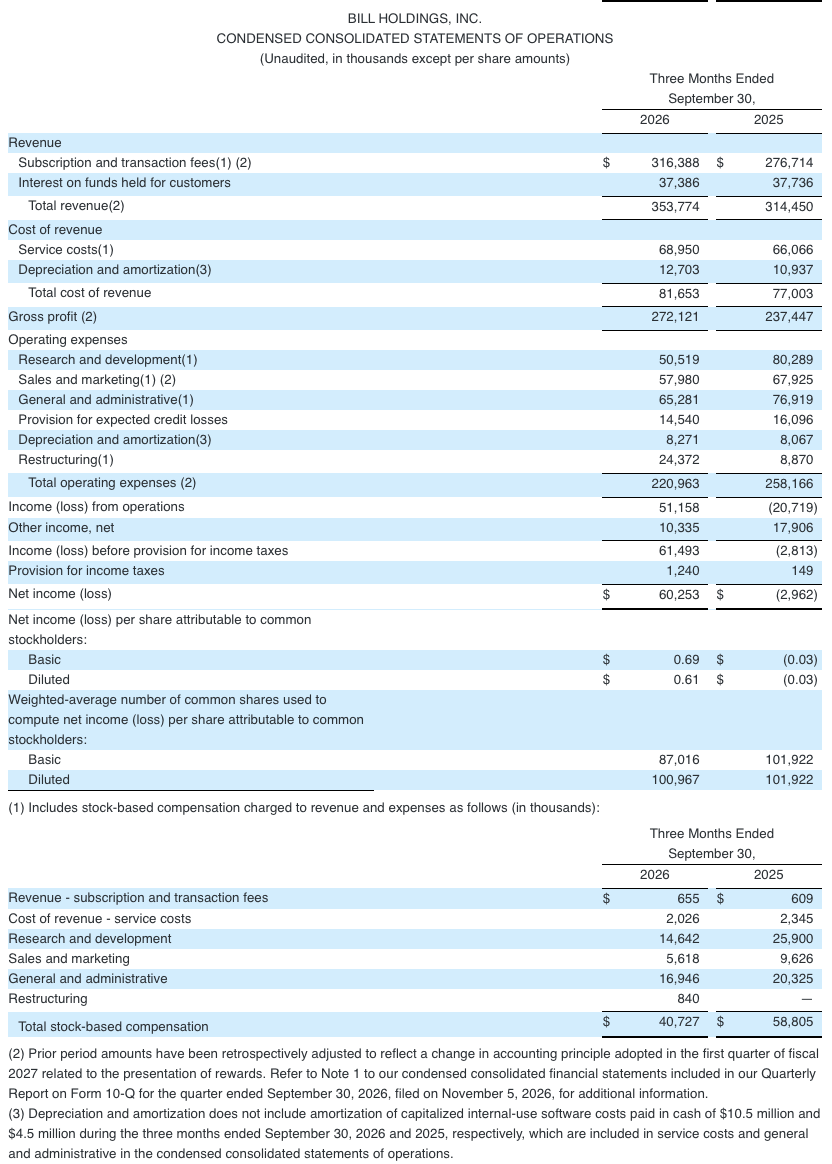
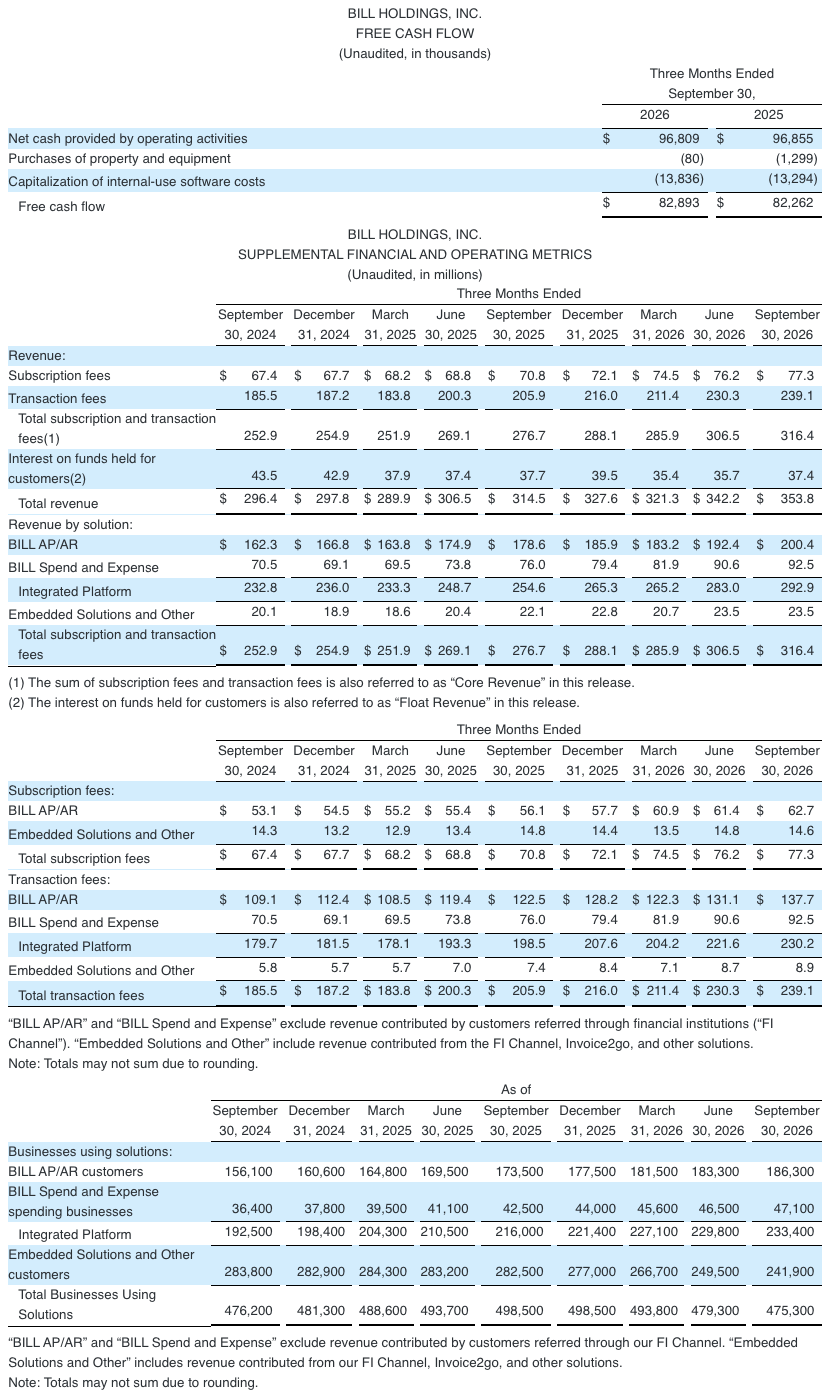
- Total revenue was $353.8 million, an increase of 13% year-over-year.
- Core revenue, which consists of subscription and transaction fees, was $316.4 million, an increase of 14% year-over-year. Subscription fees were $77.3 million, up 9% year-over-year. Transaction fees were $239.1 million, up 16% year-over-year.
- Float revenue, which consists of interest on funds held for customers, was $37.4 million.
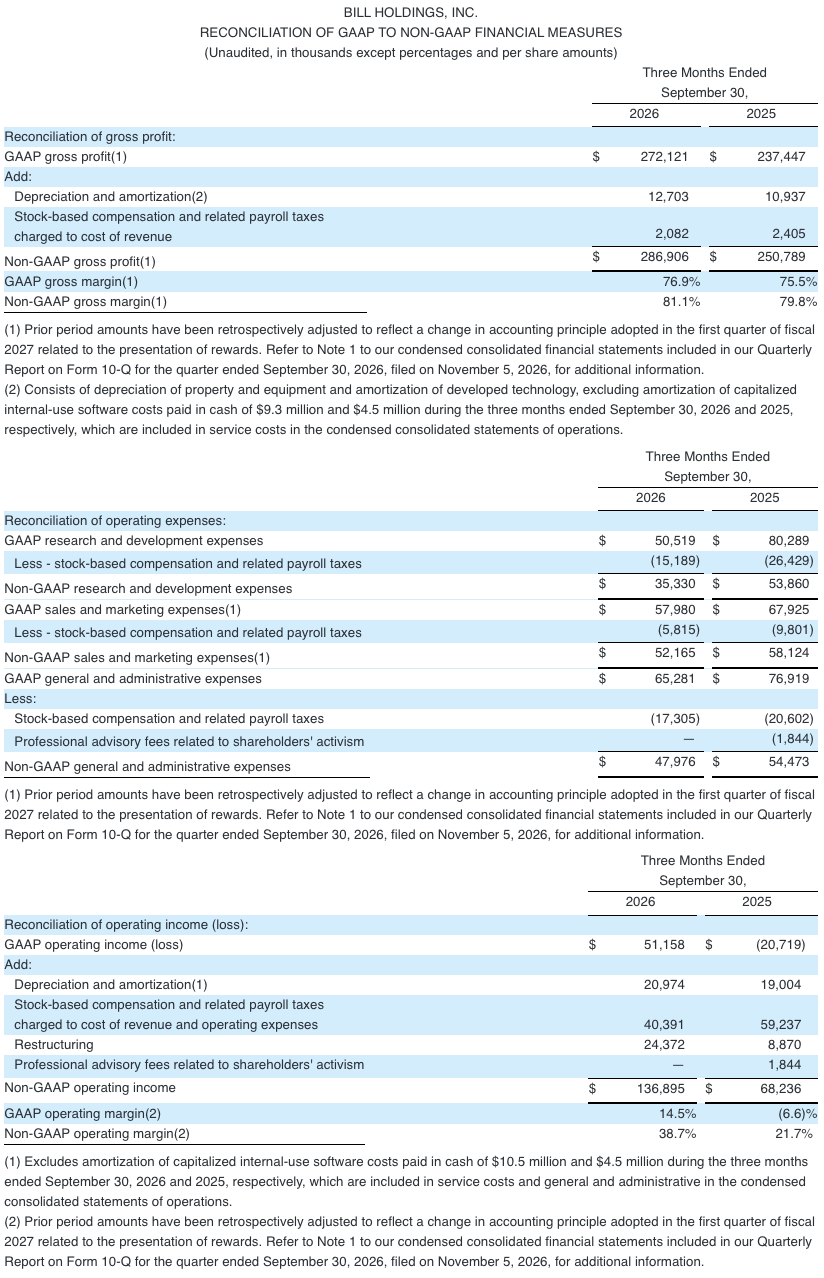
- Gross profit was $272.1 million, representing a 76.9% gross margin, compared to $237.4 million, or a 75.5% gross margin, in the first quarter of fiscal 2026. Non-GAAP gross profit was $286.9 million, representing an 81.1% non-GAAP gross margin, compared to $250.8 million, or a 79.8% non-GAAP gross margin, in the first quarter of fiscal 2026.
- Operating income was $51.2 million, compared to an operating loss of $20.7 million in the first quarter of fiscal 2026. Non-GAAP operating income was $136.9 million, compared to $68.2 million in the first quarter of fiscal 2026, an increase of 101% year-over-year.
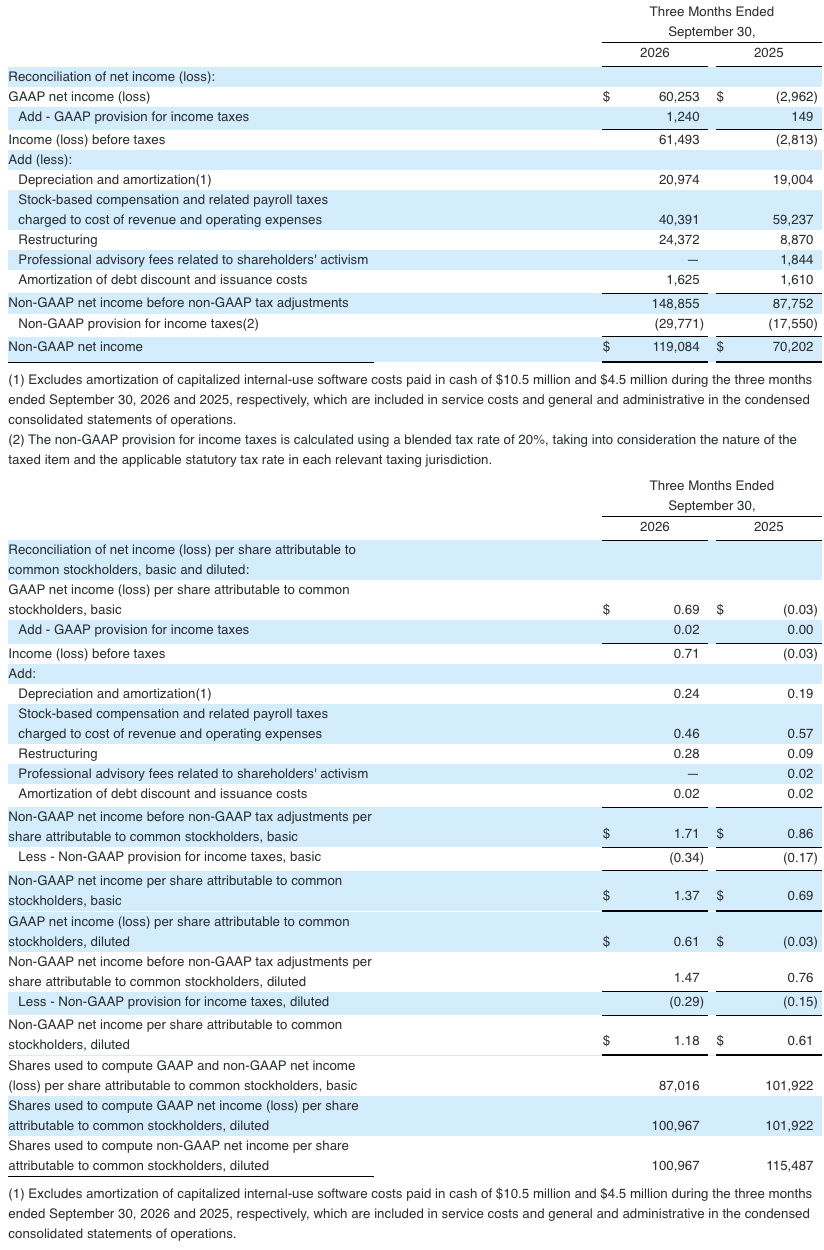
- Net income was $60.3 million, or $0.69 and $0.61 per share, basic and diluted, respectively, compared to a net loss of $3.0 million, or $(0.03) per basic and diluted share, in the first quarter of fiscal 2026. Non-GAAP net income was $119.1 million, or $1.18 per diluted share, compared to non-GAAP net income of $70.2 million, or $0.61 per diluted share, in the first quarter of fiscal 2026.
Business Highlights and Recent Developments:
- Served 475,300 businesses using our solutions as of the end of the first quarter. 1
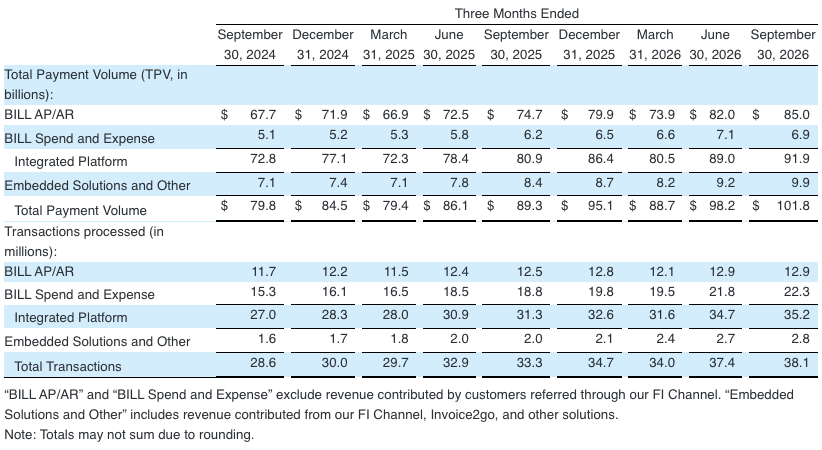
- Processed $102 billion in total payment volume in the first quarter, an increase of 14% year-over-year.
- Processed 38 million transactions during the first quarter, an increase of 14% year-over-year.
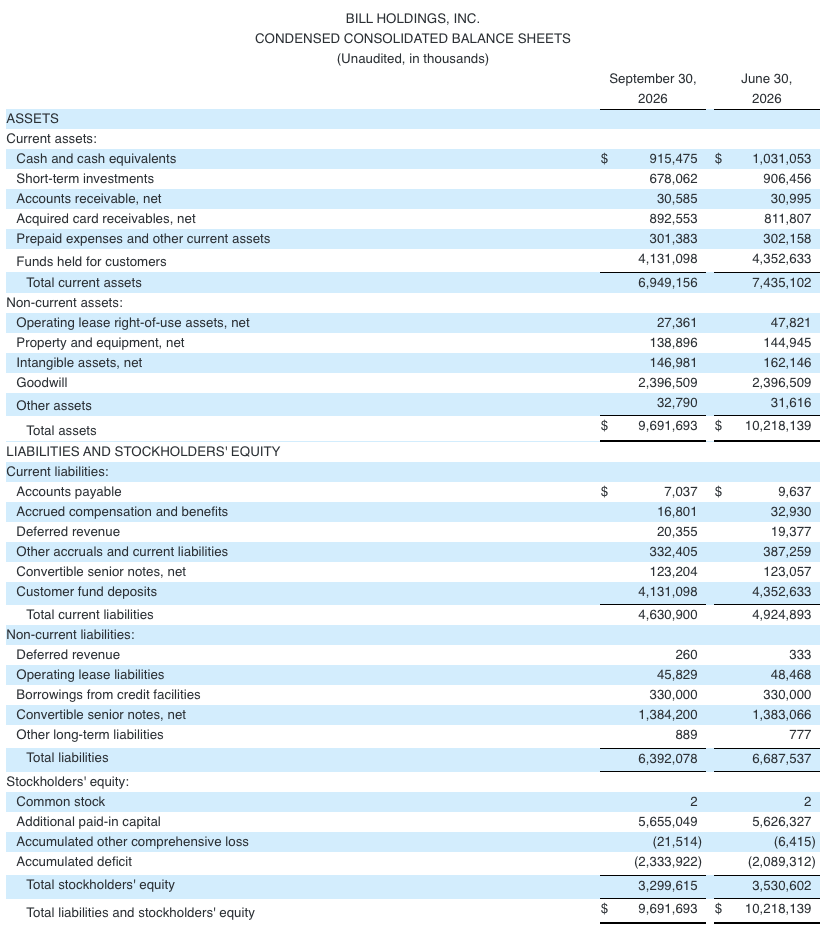
- Repurchased approximately 7 million shares of BILL common stock in the first quarter for a total cost of approximately $305 million.
Financial Outlook
We are providing the following guidance for the fiscal second quarter ending December 31, 2026 and the full fiscal year ending June 30, 2027.
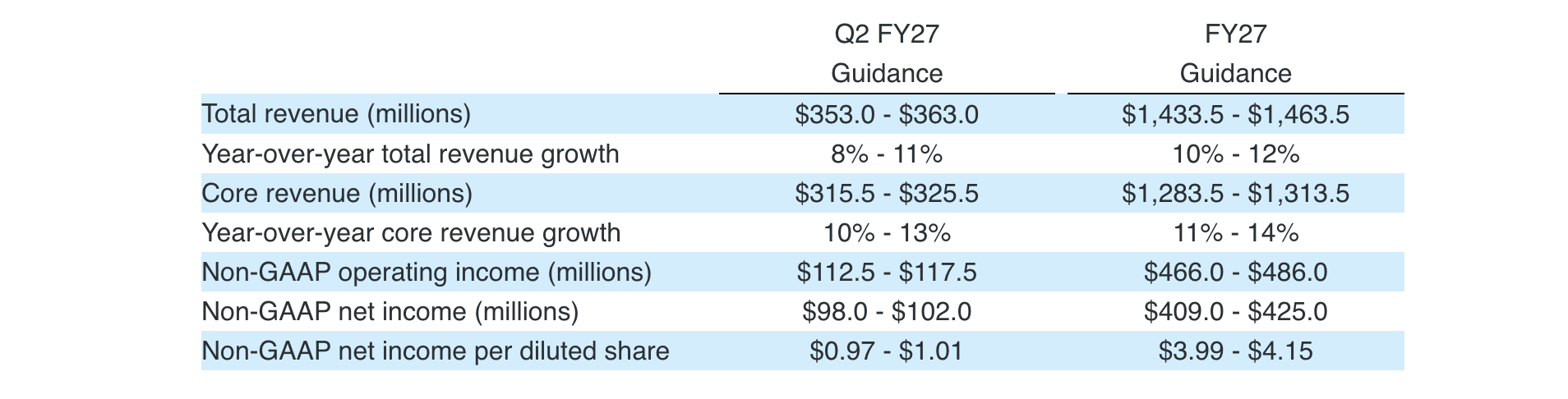
The outlook for non-GAAP net income and non-GAAP net income per diluted share includes a non-GAAP provision for income taxes of 20%. The outlook for non-GAAP net income per diluted share does not take any future repurchases of BILL shares into account, as the impact of such repurchases on a per diluted share basis is not reasonably estimable.
These statements are forward-looking and actual results may differ materially. Refer to the “Note on Forward-Looking Statements” below for information on the factors that could cause our actual results to differ materially from these forward-looking statements.
Refer to “Non-GAAP Financial Measures” below for additional information on our non-GAAP financial measures and to the reconciliation tables at the end of this press release for the reconciliation of GAAP and non-GAAP results. BILL has not provided a reconciliation of its non-GAAP operating income, non-GAAP operating margin, non-GAAP net income or non-GAAP net income per diluted share guidance to the most directly comparable GAAP measures because certain items excluded from GAAP cannot be reasonably calculated or predicted at this time. Accordingly, a reconciliation is not available without unreasonable effort.
Conference Call and Webcast Information
In conjunction with this announcement, BILL will host a conference call for investors at 1:30 p.m. PT (4:30 p.m. ET) today to discuss fiscal first quarter 2027 results and our outlook for the fiscal second quarter ending December 31, 2026 and fiscal year ending June 30, 2027. The live webcast and a replay of the webcast will be available at the Investor Relations section of BILL’s website: https://investor.bill.com/events-and-presentations/default.aspx.
___________________________
1 Businesses using more than one of our solutions are included separately in the total for each solution utilized.
About BILL
BILL (NYSE: BILL) is the intelligent finance platform trusted by nearly half a million businesses and their accountants to manage, move, and maximize their money. BILL powers businesses ranging from fast-moving startups to growing companies with complex operations. We use AI to deliver strategic finance capabilities in one integrated platform that includes AP, AR, expenses, forecasting, procurement and more. With a member network of more than 9 million, BILL’s platform processes over 1% of U.S. GDP annually. Headquartered in San Jose, California, BILL is a trusted partner of leading U.S. financial institutions, accounting firms, and software providers. For more information, visit bill.com.
Note on Forward-Looking Statements
This press release and the accompanying conference call contain forward-looking statements within the meaning of the Private Securities Litigation Reform Act of 1995, which are statements other than statements of historical facts, and statements in the future tense. Forward-looking statements are based on our expectations as of the date of this press release and are subject to a number of risks, uncertainties and assumptions, many of which involve factors or circumstances that are beyond our control. These statements include, but are not limited to, statements regarding our expectations of future performance, including guidance for our total revenue, core revenue, non-GAAP operating income, non-GAAP operating margin, non-GAAP net income, and non-GAAP net income per diluted share for the fiscal second quarter ending December 31, 2026 and full fiscal year ending June 30, 2027, our expectation for our performance on a “Rule of 40” basis, our expectations for GAAP profitability and stock-based compensation expense, planned investments in fiscal year 2027, our revenue growth and profitability profile in future years, activity under our share repurchase program, including the timing, manner, amount, and impact of any repurchases, our expectations for the growth of demand for our platform and the expansion of our customers’ utilization of our services and the development, deployment and adoption of AI-enabled products and capabilities. These risks and uncertainties include, but are not limited to macroeconomic factors, including changes in interest rates, significant political and regulatory developments or changes in trade policy, including government budget cuts, government shutdowns, the imposition of tariffs and other trade barriers, inflationary, recessionary, and volatile market environments, as well as fluctuations in foreign exchange rates, our history of operating losses, our recent rapid growth, the large sums of customer funds that we transfer daily, the risk of loss, errors and fraudulent activity, credit risk related to our BILL Divvy Cards and our invoice financing offering, our ability to attract new customers and convert trial customers into paying customers, our ability to develop, deploy, commercialize and realize expected benefits from AI agents and other AI-enabled tools, our ability to invest in our business and develop new products and services, increased competition or new entrants in the marketplace, potential impacts of acquisitions, investments and other strategic transactions, changes to card network rules and interchange fee rates, changes in accounting principles, the timing and impact of any release of our valuation allowance related to our deferred tax assets, our relationships with accounting firms, financial institutions and software providers, the global impacts of ongoing geopolitical conflicts, the actual and expected impacts of the above factors on the SMBs we serve and other risks detailed in the registration statements and periodic reports we file with the Securities and Exchange Commission (SEC), including our quarterly and annual reports, which may be obtained on the Investor Relations section of BILL’s website (https://investor.bill.com/financials/sec-filings/default.aspx) and on the SEC website at www.sec.gov. You should not rely on these forward-looking statements, as actual results may differ materially from those contemplated by these forward-looking statements as a result of such risks and uncertainties. All forward-looking statements in this press release are based on information available to us as of the date hereof. We assume no obligation to update or revise the forward-looking statements contained in this press release or the accompanying conference call because of new information, future events, or otherwise.
Non-GAAP Financial Measures
In addition to financial measures prepared in accordance with U.S. generally accepted accounting principles (GAAP), this press release and the accompanying tables contain, and the conference call will contain, non-GAAP financial measures, including non-GAAP gross profit, non-GAAP gross margin, non-GAAP operating expenses, non-GAAP operating income, non-GAAP operating margin, non-GAAP net income, non-GAAP net income per share, basic and diluted, and free cash flow. The non-GAAP financial information is presented for supplemental informational purposes only and is not intended to be considered in isolation or as a substitute for, or superior to, financial information prepared and presented in accordance with GAAP.
Investors are cautioned that there are material limitations associated with the use of non-GAAP financial measures as an analytical tool.
We exclude the following items from non-GAAP gross profit and non-GAAP gross margin:
- stock-based compensation and related payroll taxes
- depreciation and amortization
We exclude the following items from non-GAAP operating expenses and non-GAAP operating income:
- stock-based compensation and related payroll taxes
- depreciation and amortization
- restructuring
- professional advisory fees related to shareholders’ activism
We exclude the following items from non-GAAP net income and non-GAAP net income per share:
- stock-based compensation and related payroll taxes
- depreciation and amortization
- restructuring
- professional advisory fees related to shareholders’ activism
- amortization of debt discount and issuance costs
- non-GAAP provision for income taxes
It is important to note that the particular items we exclude from, or include in, our non-GAAP financial measures may differ from the items excluded from, or included in, similar non-GAAP financial measures used by other companies in the same industry. We also periodically review our non-GAAP financial measures and may revise these measures to reflect changes in our business or otherwise, including our blended U.S. statutory tax rate.
We believe that these non-GAAP financial measures provide useful information about our financial performance, enhance the overall understanding of our past performance and future prospects, and allow for greater transparency with respect to important metrics used by our management for financial and operational decision-making. We believe that these measures provide an additional tool for investors to use in comparing our core financial performance over multiple periods with other companies in our industry.
We adjust the following items from one or more of our non-GAAP financial measures:
Stock-based compensation and related payroll taxes charged to cost of revenue and operating expenses.We exclude stock-based compensation, which is a non-cash expense, and related payroll taxes from certain of our non-GAAP financial measures because we believe that excluding these items provides meaningful supplemental information regarding operational performance. In particular, companies calculate stock-based compensation expenses using a variety of valuation methodologies and subjective assumptions while the related payroll taxes are dependent on the price of our common stock and other factors that are beyond our control and do not correlate to the operation of our business.
Depreciation and amortization.We exclude depreciation and amortization from certain of our non-GAAP financial measures because we believe that excluding this non-cash charge provides meaningful supplemental information regarding operational performance. Depreciation and amortization do not include amortization of capitalized internal-use software costs paid in cash. Although we exclude amortization of developed technology from certain of our non-GAAP financial measures, the revenue generated by these acquired intangible assets is included in those measures.
Restructuring.We exclude costs incurred in connection with formal restructuring plans, including reductions-in-force and a non-cash impairment charge on operating lease right-of-use assets and property and equipment from certain of our non-GAAP financial measures because these costs are exceptional and would not otherwise have been incurred in the normal course of our business operations.
Professional advisory fees related to shareholders’ activism.We exclude costs associated with incremental professional advisory fees incurred in connection with activist shareholders, as these costs are atypical and do not reflect costs incurred from our regular engagement with shareholders.
Amortization of debt discount and issuance costs.We exclude amortization of debt discount and issuance costs associated with our issuance of our convertible senior notes and credit arrangement from certain of our non-GAAP financial measures because we believe that excluding this non-cash interest expense provides meaningful supplemental information regarding our operational performance.
Non-GAAP provision for income taxes.Consists of assumed provision for income taxes based on the statutory tax rate taking into consideration the nature of the taxed item and the relevant taxing jurisdiction.
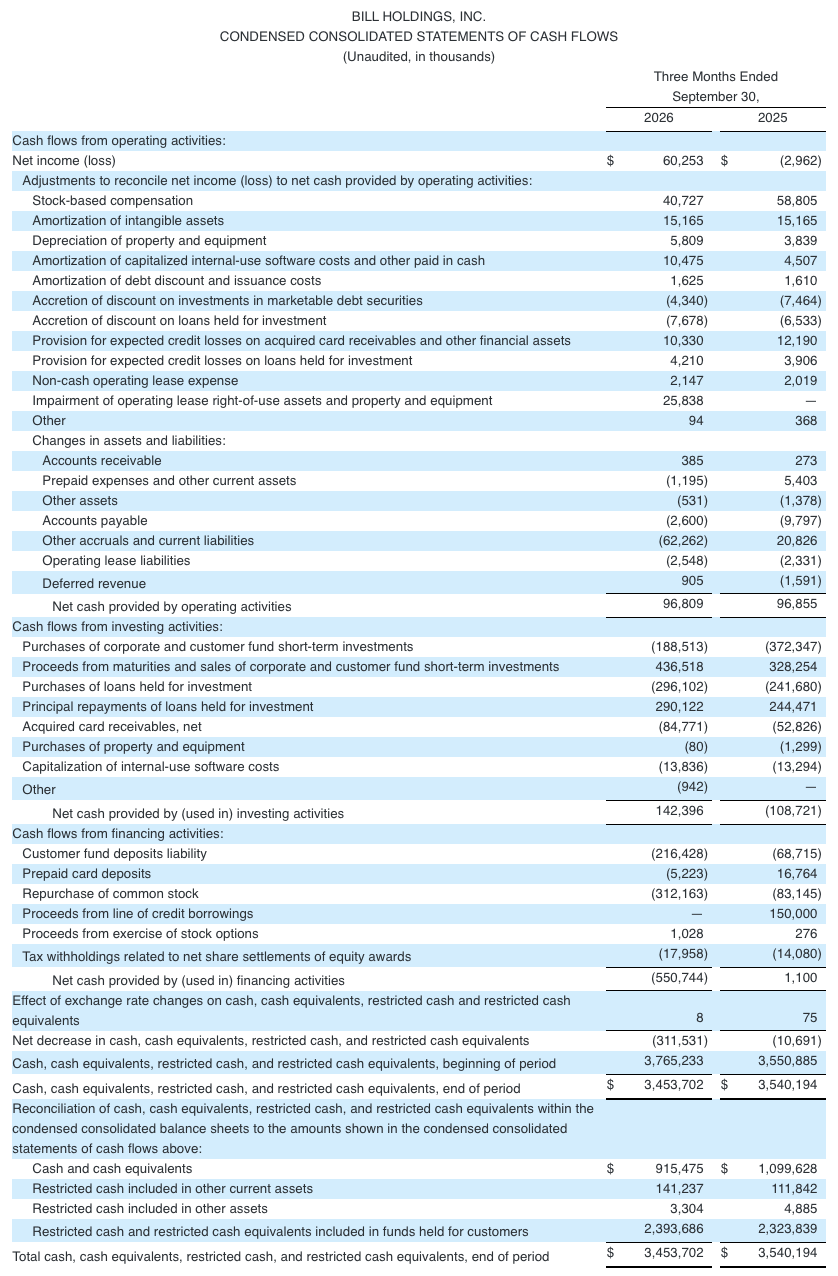
In addition, free cash flow is a non-GAAP measure defined as net cash provided by operating activities, adjusted by purchases of property and equipment and capitalization of internal-use software costs. We believe free cash flow is an important liquidity measure of the cash that is generated, after incurring operating expenses, purchases of property and equipment and capitalization of internal-use software costs, for future operational expenses and investment in our business. Free cash flow is useful to investors as a liquidity measure because it measures our ability to generate or use cash in the ordinary course of business. One limitation of free cash flow is that it does not reflect our future contractual commitments. Additionally, free cash flow does not represent the total increase or decrease in our cash balance for a given period. Once our business needs and obligations are met, cash can be used to maintain strong balance sheets and invest in future growth.
There are material limitations associated with the use of non-GAAP financial measures since they exclude significant expenses and income that are required by GAAP to be recorded in our financial statements. Please see the reconciliation tables at the end of this press release for the reconciliation of GAAP and non-GAAP results.
IR Contact:
Jack Andrews
investor@ir.bill.com
Press Contact:
Lauren Johns
pr@hq.bill.com