Managing business expenses manually costs more than most SMBs realize. The top expense reporting tools for 2026 combine receipt capture, approval workflows, corporate cards, and direct accounting integrations in one platform. For SMBs that need spend management alongside AP and AR automation, BILL offers the most complete financial operations platform available.
What to look for in an expense reporting tool?
Before comparing specific platforms, SMB finance managers should evaluate tools against five criteria.
Receipt capture and OCR accuracy
Modern tools use optical character recognition (OCR) and AI to extract merchant name, date, and amount from a photo. The best platforms auto-populate expense fields and flag anomalies without manual input. BILL AI recognizes patterns in your workflow and captures key invoice fields with 95% accuracy from day one.¹
Approval workflows
Multilevel approval chains — triggered by spend amount, category, or department — prevent policy violations before they happen. Look for configurable rules, not just on/off toggles.
Corporate card programs
Integrated corporate cards (virtual and physical) let finance teams set per-card spend limits and restrict categories in real time, eliminating after-the-fact reimbursement headaches.
Accounting software integrations
Expense data trapped in a siloed tool creates reconciliation bottlenecks. Direct, two-way syncs with QuickBooks Online, NetSuite, Xero, and Sage are non-negotiable for most SMB finance teams. BILL provides two-way integrations for 100% of the highly rated ERP and accounting platforms used by growing companies.²
Total cost of ownership
Per-user pricing compounds quickly as headcount grows. Platforms with flat or usage-based pricing scale more predictably.
Top expense reporting tools for 2026: side-by-side comparison
Last updated: June 2026. Pricing and features subject to change; verify directly with each vendor.
BILL: the complete expense reporting platform for SMBs
What BILL expense reporting does differently?
Most expense reporting tools solve one problem: they track what employees spend. BILL solves a bigger problem — it connects what employees spend to how the business pays vendors, manages cash flow, and closes the books. That full-cycle view, from vendor invoice to employee receipt to payment, is what separates BILL from standalone trackers.
87% of customers surveyed agree that using BILL saves a significant amount of time compared to their previous process3. And 91% of customers surveyed agree that BILL makes them more efficient4.
BILL Spend & Expense management capabilities include:
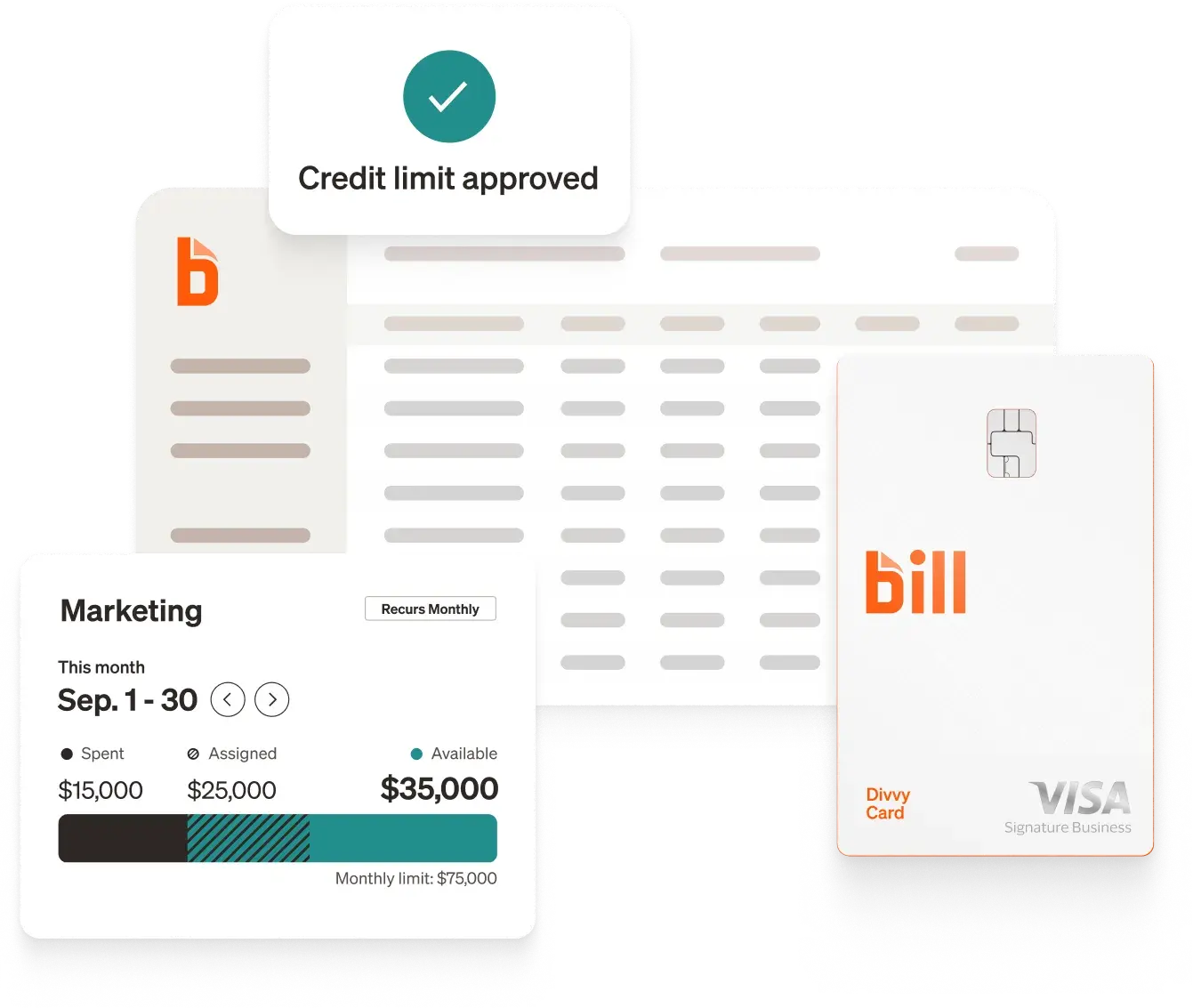
- BILL Divvy Corporate Card: Issue both virtual and physical corporate cards to employees. Virtual cards may be frozen, adjusted, or restricted by category in real time. The BILL Divvy Corporate Card program also offers credit card options, not just prepaid (giving businesses payment flexibility5).
- Budget management: Set spending budgets by team, department, or project. BILL matches expenses to budgets and alerts managers before overages occur.
- Multilevel approval workflows: Configure simple or complex approval chains. Rules trigger based on spend amount, category, or vendor — no manual routing required.
- Real-time reimbursement tracking: Monitor employee reimbursement status in real time, reducing back-and-forth between finance and employees.
- AP/AR automation in the same platform: Unlike Ramp, Expensify, or Concur, BILL handles accounts payable and accounts receivable alongside spend management. Finance teams get a single dashboard for outbound payments, inbound collections, and employee expenses.
CrewTracks, a growing construction software company, was previously juggling eight employees across two shared credit cards with no line of credit. After switching to BILL Spend & Expense, the team eliminated roughly 10 hours of expense management work per week and gave every department real-time budget visibility. "Managing our credit line and cash flow has never been so easy," said Bryant Jensen, Controller of CrewTracks. (See their story)
AI and automation in expense reporting: what BILL delivers
AI-powered invoice and receipt capture
BILL uses AI to capture and extract data from invoices and receipts, automatically populating fields like vendor name, amount, date, and expense category. BILL AI extracts data from about 220,000 documents every day6 — a capability that benefits finance teams handling high transaction volumes. Invoice data extraction for common fields is approximately 99% accurate7.
Automated approval routing
Rather than manually forwarding expense reports, BILL routes submissions based on rules the finance team configures. A $500 expense may require one approver while a $5,000 submission escalates to a department head. 84% of customers surveyed agree that BILL has eliminated hours of manual work from their weekly routine8.
Smart spend categorization
BILL categorizes transactions based on merchant data and historical patterns. This reduces miscoding, speeds up month-end close, and ensures expense reports feed cleanly into accounting software. 85% of customers surveyed agree that using BILL has made their month-end close process faster9.
Real-time spend visibility
Finance managers see live dashboards showing spending by employee, department, category, and budget. Anomalies surface immediately rather than at month's end.
Key integrations: why accounting sync matters
One of the most important factors in evaluating expense reporting tools is the quality of accounting integrations. A tool that exports a CSV file is not the same as a tool with a live, two-way sync.
BILL integrates directly with major ERPs and more:
- QuickBooks Online: Expense data, vendor payments, and invoice records sync automatically. Finance teams avoid duplicate entry and reduce reconciliation time.
- NetSuite: For SMBs using NetSuite as their ERP, BILL provides a direct connection that keeps both platforms aligned on vendor records, payment status, and expense categories.
- Sage: BILL supports Sage integration for businesses using that accounting environment.
- Xero: Available for teams on Xero's ecosystem.
In a 2026 survey, more than 80% of customers say using BILL integrations feels like adding capacity to their finance team without increasing headcount10. Customers report spending 85% less time on GL reconciliations compared to non-customers11.
How to choose the right expense reporting tool in 2026
Step 1: Audit your current pain points
Are employees submitting paper receipts? Is the month-end close delayed because of missing expense data? Are you managing vendor invoices in a separate tool from employee expenses? The answers determine which features matter most.
Step 2: Assess your team structure
If your team is primarily remote or field-based, SMS receipt submission and mobile app quality become critical. If your team is office-based with a centralized finance function, workflow automation and accounting integration may matter more.
Step 3: Evaluate total cost
Per-user pricing sounds affordable at five employees but compounds quickly at fifty. Flat-rate or usage-based models are often more predictable. Factor in implementation time, training costs, and any required minimum deposits.
Step 4: Test integration depth
Request a demo specifically focused on accounting integration. Watch how an expense flows from employee submission to accounting entry. Shallow integrations create manual reconciliation work that negates automation benefits.
Step 5: Consider growth trajectory
A tool that fits today may not fit in 18 months. Platforms like BILL that combine AP automation, AR automation, and spend and expense management scale with operational complexity without requiring a platform migration.
Why BILL: the complete SMB financial operations platform
BILL is not just an expense reporting tool, it is a financial operations platform built for businesses of all sizes. Here is what that means in practice.
AP and AR in one place. Finance teams manage outbound vendor payments and inbound customer collections from the same dashboard. No switching between tools, no reconciliation gaps. Learn more about BILL's accounts payable automation.
BILL Divvy Corporate Card. Issue virtual and physical cards with per-card spending limits, category restrictions, and real-time freeze capabilities. Both prepaid and credit card options are available — giving SMBs flexibility that charge-card-only platforms cannot provide12.
No deposit minimums or eligibility barriers. BILL does not require a $25,000 bank balance or limit access to corporations and LLCs. Sole proprietors, early-stage businesses, and growing SMBs may all access the platform.
Network scale. As of September 30, 2025, 498,000 businesses use BILL's solutions13. That network includes vendors and suppliers already transacting on the platform, reducing onboarding friction and accelerating payment workflows.
International payments. For SMBs with international vendors or suppliers, BILL supports cross-border payments in 137 countries and 106 currencies14— a capability that standalone expense tools do not offer.
Deep accounting integrations. Two-way syncs with QuickBooks Online, NetSuite, Sage, and Xero keep books current without manual exports. Compare BILL to Ramp, Expensify, or Concur to see the full picture.
Disclaimers
1. BILL is a registered Money Services Business with FinCEN and is a licensed money transmitter across the United States.
2. This article is for informational purposes only. Feature availability, pricing, and eligibility requirements are subject to change. Verify current details directly with each vendor before making a purchasing decision.
Footnotes
[1] Data based on 1 year of invoices for key extraction fields where the field was contained in the invoice.
[2] Based on G2's Accounting Software category rankings as of February 2026. "Highly rated" = top seven platforms with G2 score 4.0+, at least 800 user reviews.
[3] Based on a 2026 BILL survey sent to customers.
[4] Based on a 2026 BILL survey sent to customers.
[5] The BILL Divvy Card may be issued by one of Divvy Pay, LLC's bank partners. The BILL Divvy Card is not a deposit product. For your specific lender, see your Card Agreement.
[6] AI narrative document.
[7] Based on BILL's analysis of the top 20% of common bills assuming doc layouts and user behaviors stay consistent. Results will vary by invoice layout and data quality.
[8] Based on a 2026 BILL survey sent to customers.
[9] Based on a 2026 BILL survey sent to customers.
[10] Based on a 2026 BILL survey sent to customers.
[11] Based on a BILL survey conducted in January 2026.
[12] Based on a 2026 BILL survey comparing time spent for customers vs. non-customers.
[13] FY2026 Q1 investor deck (Nov 2025).
[14] BILL International Payments website.
[15] Internal data.
[16] Internal data.
[17] Based on a 2026 BILL survey comparing time spent for customers vs. non-customers.