What do SMBs save with AP and AR automation?
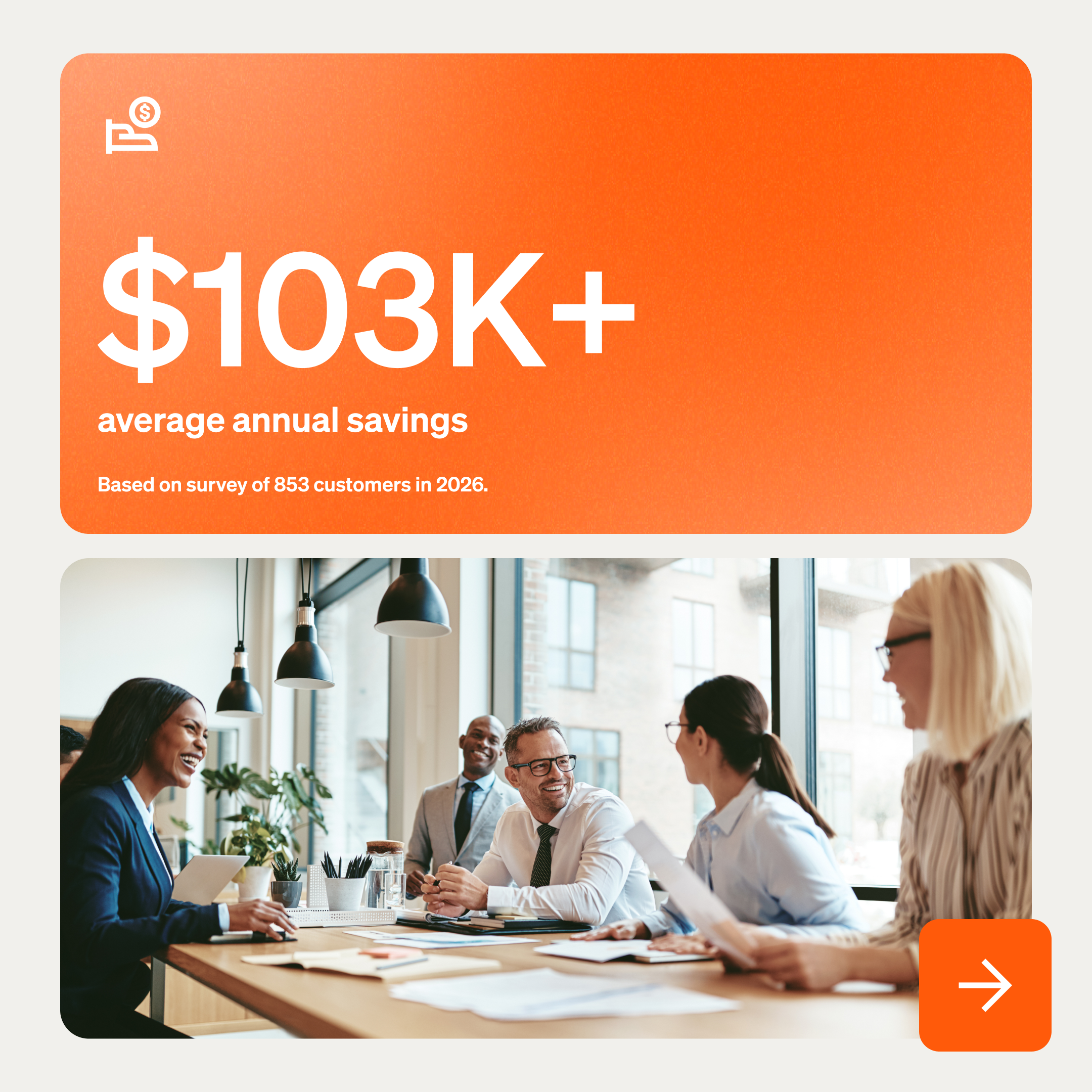
For a small finance team, software decisions come down to one question: what does it return? In April 2026, UserEvidence surveyed 893 BILL customers who use accounts payable and accounts receivable at organizations with fewer than 50 employees. Respondents reported average estimated annual savings of $103,900 per year, and labor made up the largest share.1
These are self-reported averages, and individual results vary. For a deeper look at how finance teams frame the math, see this overview of accounts payable automation ROI.
Why do SMB finance teams outgrow manual AP and AR?
Before adopting BILL, 90% of respondents used manual methods or had no dedicated AP or AR solution.1 The majority, 55%, managed payables and receivables mainly through paper, email, and spreadsheets. Another 22% relied on limited functionality in their accounting software and 17% used bank bill pay tools, which may not be designed specifically for the accounts payable process or the accounts receivable process.1
Respondents named these challenges with their previous approach1:
- Manual paper check processes (66%)
- Time-consuming bill pay or invoicing workflows (59%)
- No centralized system for managing bills and invoices (32%)
- Inefficient or hard-to-manage approval workflows (32%)
- Limited tracking of vendor payments or receivables (26%)
- Difficult or lengthy month-end reconciliation (25%)
Paper checks and email approvals also leave thin records, which makes audit trails and accounts payable internal controls harder to maintain. Laureen M. Burtless, Accounting Manager at Gastroenterology Associates, PA, described the shift this way: "[BILL] has reduced staff time to manually input invoices, run checks, get checks signed, stuff envelopes, and run postage. It has made a tremendous difference in the volume my staff can now process as we have grown and now operate 6 companies."3
Why do customers choose BILL AP and AR?
Ease of use was the top reason respondents chose BILL. The next factors were digital payments, integration with accounting software, automated bill capture and data entry, and automated approval workflows. The majority of respondents (61%1) reported realizing value in under a month, and 47%1 reported seeing value in less than two weeks.
How much time do AP and AR automation features save?
Respondents reported saving 24 hours per week across seven finance activities, and each activity showed a decrease of at least 45% in hours spent.
Based on an average time savings of 1,248 hours per year and an estimated accounting manager salary of $127,500, roughly $61 per hour, according to the Robert Half salary guide (2026), the estimated value of that time is $76,100. This is a calculated figure, not a reduction in payroll. Respondents also reported a month-end close that is 2.5 days faster, a result that connects to broader practices for how teams accelerate the month-end close.
Respondents also described the work as easier. The share who said manual invoice entry and payment processing was easy rose from 13%1 before BILL to 77%1 after, and the share who said the same of managing invoice approvals rose from 13%1 to 80%.1 BILL features related to these tasks include automated invoice capture, customizable approval workflows, and the mobile app for approvals and payment management on the go.

Where do error, fraud, and late-payment losses drop?
Errors and fraud
Respondents reported a 75%1 decrease in loss from payment errors and a 67%1 decrease in loss from fraud or unauthorized payments, which respondents estimated at about $600 and $400 per month. Across 12 months, that adds $12,000 to the estimated savings figure. Automated bill capture from BILL can code multi-line-item bills and check invoices against POs and receipts, a step often called invoice matching. BILL AI recognizes patterns in your workflow and captures key invoice fields with 95% accuracy from day one.4
BILL offers payment controls and custom approval workflows that can help teams review payments before they are sent. For background on the risk, see this guide to accounts payable fraud.
On-time payments
Respondents reported a 71%1 decrease in late AP payments and a 56%1 decrease in late AR payments. They also reported a 50%1 decrease in late payment fees and a 50% decrease in missed early payment discounts. That equals $300 per month in reduced late fees and $200 per month in reduced missed discounts, or $6,000 per year. Automated payment scheduling and due date tracking support those results, and options such as ACH payments, card payments, and international wire transfers give vendors flexibility.
Collections
Respondents reported a 75%1 decrease in losses from unpaid invoices, an average of $600 less per month, or $7,200 per year. Automated invoice reminders and AR visibility support that outcome. Teams looking for more tactics can review how to reduce late payments from customers.
Tool consolidation
Respondents reported retiring both their previous primary solution and an additional one, which contributed an estimated $2,600 per year. Some respondents also use BILL beyond AP and AR: 46% use bill pay, 29% use BILL Spend & Expense, and 19% use invoicing.
What do teams do with the time they get back?
Seventy-nine percent of respondents realized at least one workforce benefit: reduced team stress or improved morale, reallocated staff time to higher-value tasks, avoided hiring, or reduced staffing needs. Those who reduced staffing needs and those who avoided new hires both reported an average savings of nearly one full-time employee’s worth of capacity, an estimated value of up to $127,500 in salary equivalent.² This figure is separate from, and not included in, the $103,900 average. Respondents named financial planning and forecasting, cash flow management, process improvements, and vendor relationship management among the work they took on.
Staying power also showed up in the data: 93%1 of respondents said replacing BILL would be difficult, and 67%1 agreed BILL makes it easier for their organization to scale as transaction volume grows.
Bright & Associates, an outsourced bookkeeping and CFO firm for churches and nonprofits, reports using BILL Accounts Payable and Spend & Expense for about 90% of its client base.3
How does BILL fit with existing accounting software?
BILL integrates with leading accounting software: QuickBooks, Xero, Oracle NetSuite, Sage Intacct, and Microsoft Dynamics. See more BILL integrations. Respondents ranked fit with their accounting software as a top-three reason for choosing BILL.
How was the survey conducted?
UserEvidence, a third-party research firm, surveyed 893 BILL AP and AR customers in April 2026. All respondents came from organizations with fewer than 50 employees across industries including nonprofit, professional services, construction, financial services, healthcare, retail, and the public sector. Thirty-eight percent were C-suite or executives and 25% were senior leadership, and 46% were administrators in BILL.
Frequently asked questions
How much do small businesses save with AP and AR automation?
Surveyed BILL customers with fewer than 50 employees reported average estimated savings of $103,900 per year. The estimated value of time saved was $76,100, followed by $7,200 each from fewer payment errors and fewer missed customer payments. Individual results vary, and the survey reflects self-reported averages.
How quickly do teams see value after adopting BILL AP and AR?
Sixty-one percent1 of respondents reported realizing value in under a month, and 47%1 reported seeing it in less than two weeks. Ease of use was the top reason respondents gave for choosing BILL, which may help explain the timeline.
Does BILL AP and AR work with QuickBooks or Xero?
BILL integrates with leading accounting software: QuickBooks, Xero, Oracle NetSuite, Sage Intacct, and Microsoft Dynamics. Browse integrations from BILL in the integrations directory or review the AP toolkit for small business.
What should finance teams evaluate when comparing AP automation tools?
Respondents pointed to ease of use, digital payments, accounting software compatibility, automated bill capture, and automated approval workflows as the factors that influenced adoption. The AP automation buyer's guide and a primer on accounts payable automation cover those criteria in more detail.
Disclosures
1 Self-reported results from a survey of 893 BILL AP and AR customers with fewer than 50 employees, conducted by UserEvidence during April 2026. Individual outcomes will vary and are not guaranteed.
2 Estimated value of time saved, calculated at about $61 per hour. Not a guarantee of payroll reduction
3 The results discussed in this article are for informational purposes only and are not meant as a guarantee or promise of any result. Results vary and depend on various factors.
4 Data based on 1 year of invoices for key extraction fields where the field was contained in the invoice.
The BILL Divvy Card may be issued by one of Divvy Pay, LLC's bank partners (bill.com/bank-partners). The BILL Divvy Card is not a deposit product. For your specific lender, see your Card Agreement.
This content is presented "as is," for informational purposes and is not intended to provide tax, legal or financial advice. Please consult your advisor with any questions.