Home

5 Best Brex alternatives & competitors in 2026

The BILL Team
illustrated hand holding a device with a dollar signHeader imageHeader imageHeader imageHeader image
Table of contents

Quick answer: For small and midsize businesses, BILL is the Brex alternative to start with. It pairs spend and expense management at $0 per user[1] with AP and AR on one platform and offers a predictable credit line option[2]. BILL is trusted by more SMBs and accountants than anyone in our space: nearly half a million customers, more than 9,500 accounting firms[3]. Other options include Airbase, Navan, Mercury, and Ramp.

Key takeaways

BILL is the top replacement because it manages spending, bills, and payments together for free per user.

Many small businesses are leaving Brex because it was bought by Capital One and stopped serving smaller companies.

Other popular options to replace Brex include Ramp, Mercury, Navan, and Airbase depending on your business needs.

Brex built its name as a corporate card for venture-backed startups. Two changes have sent many finance teams looking for Brex alternatives. In June 2022, Brex stopped serving traditional small businesses[4]. Then Capital One announced a $5.15 billion agreement to acquire Brex in January 2026 and completed the deal on April 7, 2026, making Brex a Capital One subsidiary[5].

If you run finance for a product business, a professional services firm, or any company that doesn't fit a startup profile, this guide compares five Brex competitors on pricing, credit, AP and AR depth, and what users say on G2.

Brex alternatives at a glance†

Platform Best for Starting price G2 rating
BILL SMBs and midsize companies that want spend, AP, and AR in one platform Spend & Expense $0/user/month; AP/AR from $49/user/month[6] Spend & Expense 4.5 (2,200+ reviews)[7];
AP/AR 4.4 (1,800+ reviews)[8]
Airbase (Paylocity for Finance) Midsize companies already using Paylocity HR and payroll Custom quote[9] 4.7 (1,800+ reviews)[10]
Navan Companies where travel is the largest spend category Travel free up to 300 employees; expense $15/user/month after 5 users[10] 4.7 (9,000+ reviews)[10]
Mercury Startups that want banking first $0 base plan; paid plans from $35/month[11] 4.4 (125 reviews)[12]
Ramp Teams that want a broad card-led spend platform $0; Ramp Plus $15/user/month plus platform fee[13] 4.8 (2,500+ reviews)[14]

Pricing and ratings are based on publicly available information as of September 30, 2026, and may change. Confirm details with each provider.

How we chose these Brex alternatives

We evaluated each platform on five criteria that matter to teams moving off Brex:

  • Credit and underwriting. How limits are set and how often they change.
  • Pricing and paid tiers. Per-user fees and which controls require an upgrade.
  • Financial operations depth. Whether the platform covers AP, AR, and cards, or only cards and expenses.
  • Integrations. Sync with QuickBooks, NetSuite, Sage Intacct, Xero, and other accounting systems.
  • User reviews. Ratings and recurring themes from G2.

Top 5 Brex alternatives

1. BILL

BILL is a financial operations platform that combines spend and expense management with AP and AR. As of September 30, 2025, nearly half a million businesses use BILL to help automate their financial operations[15], and as of June 30, 2025, 8.3 million network members pay or get paid with BILL[16].

Key features

  • Spend & Expense at $0 per user. Corporate and virtual BILL Divvy Cards, budgets, receipt capture, reimbursements, and reporting, with no paid tier to unlock core controls[1].
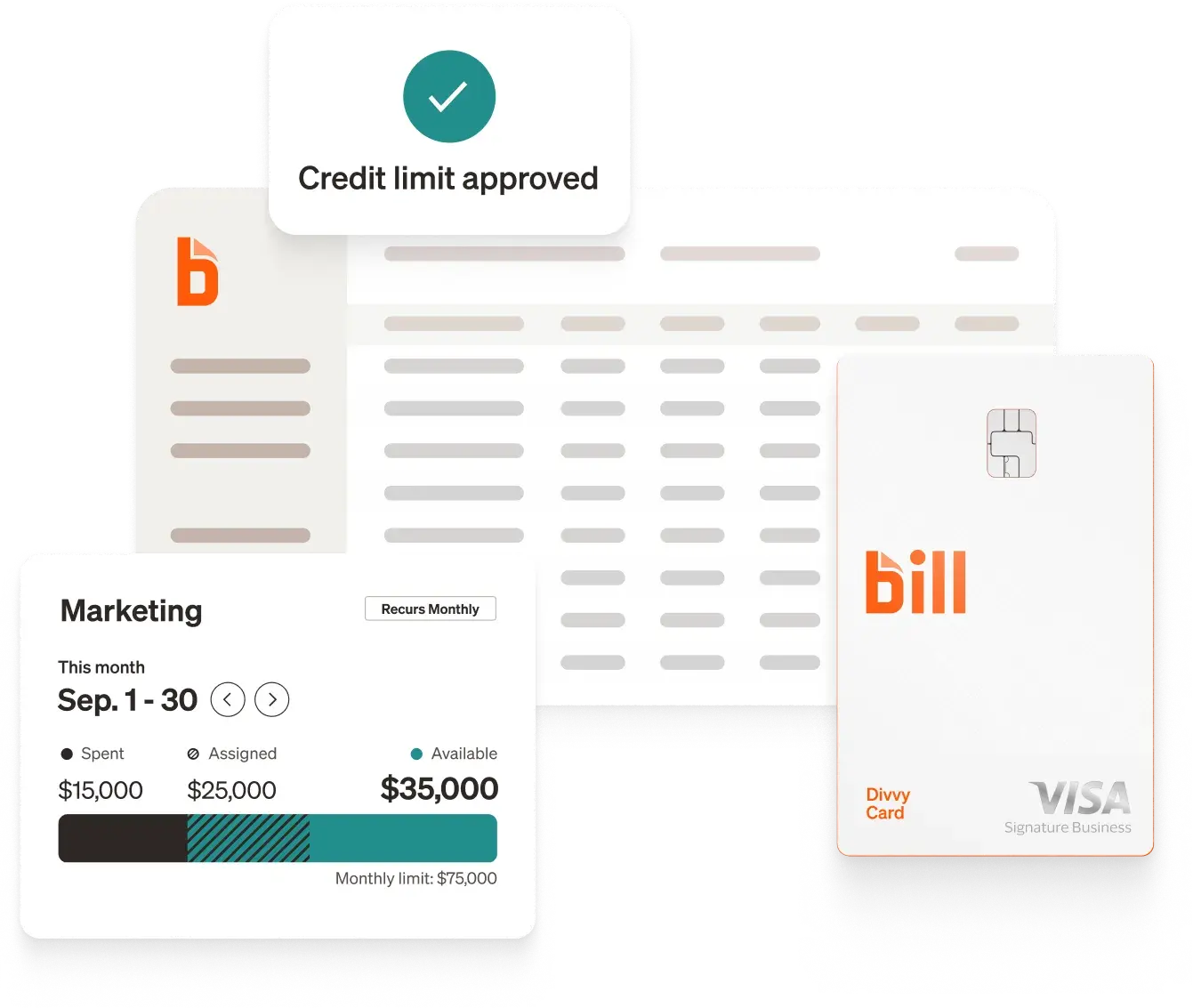
  • Credit line options. BILL offers multiple credit line options that optimize cash flow or cash back, with one predictable credit line option[2].
  • Mature AP and AR. Accounts payable automation with approvals, procurement, multi-entity support, W-9 and 1099 tools, and a vendor network, plus AR workflows for invoicing and collecting payments. Customers report saving 8 hours a week on AP compared to non-customers[17].
  • Built-in travel. BILL Travel is part of BILL Spend & Expense, so teams can book and expense trips in one place[18].
  • Cash Account. The BILL Cash Account offers a 3% APY[19] with FDIC insurance coverage up to $200M through Column N.A. and its Sweep Program Network Banks[20].
  • Accounting sync. BILL integrates with leading accounting software: QuickBooks, Xero, Oracle NetSuite, Sage Intacct, and Microsoft Dynamics[21]. Customers report spending 85% less time on GL reconciliations compared to non-customers[17].
  • AI. BILL's AI is trained on more than $1 trillion in transactions and more than 1.3 billion documents[22].
  • International payments. BILL International Payments supports 137 countries and 106 currencies[23].
  • Rewards. Points on BILL Divvy Card spend, with higher category multipliers on weekly or daily billing cycles[24].
Feature BILL Brex
Spend & expense $0/user; budgets, controls, and built-in travel[1] Strong spend and travel; advanced budgets and controls in paid tiers
Accounts payable Mature AP with procurement, multi-entity, W-9/1099, approvals, and vendor network Bill pay with basic approvals
Accounts receivable AR workflows for invoicing and collecting payments Newer AR that requires a Brex Business Account; ACH and wire only
Cash account 3% APY[19] with FDIC coverage up to $200M[20] 0% on uninvested balances; higher yield through separate treasury products
Mobile apps Mobile apps for AP, AR, spend, and travel workflows Mobile app focused on spend and travel; AP and AR not supported
ERP integrations Two-way AP/AR sync with major ERPs Card transaction sync focused; newer AP sync
Support Live chat and phone support 24/7 support; dedicated success mainly for paying customers
Credit line Multiple credit line options, including a predictable option[2] Limits based on bank balances that can change daily
Pricing Spend & Expense at $0/user plus rewards[24]; tiered AP/AR subscriptions[6] Free tier for basics; advanced features require per-user fees

[25]

BrüMate is one example. CFO Jarrod Cox stated that BILL Spend & Expense cut what "could be days of allocating that spend into an hour or two a month," and that the company produced nearly $400,000 worth of rewards over its relationship with BILL[24].

Pros

  • Spend & Expense at $0 per user, with ERP integrations included[1]
  • AP, AR, cards, and travel on one platform
  • Includes a predictable credit line option[2]
  • G2 reviewers frequently cite ease of use, time savings, and virtual card flexibility[7]

Cons

  • AP and AR require a paid per-user subscription[6]
  • Rewards carry a 12-month holding period before redemption, and category multipliers apply to the first $5,000 per month[24]
  • Some G2 reviewers report integration and sync issues[7]

Ideal for: SMBs and midsize companies, especially product businesses watching cash flow, that want cards, AP, and AR in one system without per-user fees on spend management.

Confidently automate and control your business with BILL.

2. Airbase (now Paylocity for Finance)

Paylocity completed its acquisition of Airbase on October 1, 2024[26] and now sells the product as Paylocity for Finance. It combines AP automation with payments to 200+ countries, corporate cards, AI-assisted expense reports, procurement, and headcount planning connected to Paylocity's HR and payroll data[27].

Pros

  • Spend data tied to the employee record, so card access and approvals can follow role changes[27]
  • Procurement and AP in one workflow
  • G2 reviewers frequently mention ease of use, receipt upload with automatic categorization, and accounting software integration[10]‍

Cons

  • No published pricing; quotes are custom[9]
  • Strongest when paired with Paylocity HR and payroll
  • G2 reviewers cite mobile app challenges, occasional miscategorized expenses, and a desire for more customizable reporting and international support[10]

Ideal for: Midsize companies that already run Paylocity and want HR and finance data in one place.

3. Navan

Navan is a travel and expense platform that went public on Nasdaq in October 2025[28]. It pairs corporate travel booking with cards, expense management, and reimbursements.

Pros

  • Travel booking free for companies with up to 300 employees[10]
  • 4.7 rating from 9,000+ G2 reviews[10]

Cons

  • Expense management is free for the first 5 monthly expensing users, then $15 per user per month[10]
  • Built around travel, so AP and non-travel spend are less central

Ideal for: Companies where travel is the largest spend category.

4. Mercury

Mercury is a financial technology company, not a bank, that offers business checking and savings through partner banks Choice Financial Group and Column N.A.[11] It offers FDIC coverage up to $5 million through a partner-bank sweep network, subject to conditions[29], and received preliminary conditional approval from the OCC for a national bank charter in April 2026[30].

Pros

  • $0 base plan with no minimums[11]
  • Banking, the Mercury IO card, and bill pay in one app

Cons

  • Paid plans start at $35 per month, and Mercury Pro costs $299 per month[11]
  • IO card limits are tied to Mercury balances[31]
  • Fewer G2 reviews (125) than other options on this list[12]

Ideal for: Early-stage startups that want a banking-first setup.

5. Ramp

Ramp is a spend management platform that pairs corporate cards with expense management, AP, procurement, and travel. It requires at least $25,000 in a linked U.S. business bank account to qualify[32].

Pros

  • Free plan covers cards, expenses, and bill pay[13]
  • 4.8 rating from 2,500+ G2 reviews[14]

Cons

  • Ramp Plus costs $15 per user per month plus a platform fee[13]
  • Starting June 1, 2026, Ramp added Bill Pay transaction fees of $0.59 per standard ACH and $1.99 per check, waived when paying from a Ramp Checking Account[33]
  • Credit limits can change based on connected bank balances[34]

Ideal for: Teams that want a card-led spend platform and meet the cash requirement.

Why companies are looking for Brex alternatives

Most teams evaluating Brex competitors point to three issues.

  • Ownership and roadmap. Brex now operates inside a large bank[5]. Some finance leaders want clarity on pricing, underwriting, and product priorities before signing a long-term commitment.
  • Paid tiers for core controls. Brex offers a free Essentials plan, but its Premium plan costs $12 per user per month, and features such as advanced budgets, multiple expense policies, multi-entity support, and custom ERP and HRIS integrations sit in paid tiers[35].
  • Credit limits tied to cash. Brex underwrites based on cash balance and/or revenue. With daily payments, a limit can reach 100% of the Brex account balance, and limits can drop if a linked bank account disconnects[36]. For companies that time vendor payments around cash flow, a limit that moves with the bank balance makes planning harder.

G2 reviewers rate Brex highly (4.8 out of 5 from more than 1,600 reviews), often praising ease of use and receipt capture. The most common complaints mention restrictive approvals and card and credit issues, and some reviewers describe the platform as built for high-growth startups rather than smaller or non-tech companies[37].

How to switch from Brex

Plan the move as a short project so no payment or subscription lapses.

  1. Map card-linked vendors. List each subscription and vendor charged to a Brex card and issue replacement virtual cards before closing old ones.
  2. Rebuild budgets and policies. Recreate approval chains and spend limits in the new platform before the cutover.
  3. Connect your accounting system. Set up sync with QuickBooks, NetSuite, Sage Intacct, Xero, and more and confirm your chart of accounts maps correctly.
  4. Run both systems briefly. Keep Brex active for a short overlap so traveling employees have a working card.
  5. Move AP and AR last. Once cards are stable, move vendor payments and invoicing so the back office runs in one place.

To check card eligibility, see the BILL Divvy Card requirements. For a broader look at card and expense tools, read our guide to the best expense management software.

Frequently asked questions about Brex alternatives

Does Brex still serve small businesses after the Capital One acquisition?

Brex has focused on startups and larger companies since June 2022, when it stopped serving traditional small businesses[4]. Its published requirements include a minimum cash balance for funded startups and revenue thresholds for established businesses[38]. Small businesses that don't meet those thresholds often compare BILL and Ramp instead.

Which Brex alternative has a credit line that doesn't change with my bank balance?

BILL offers multiple credit line options, including one predictable credit line option[2]. Brex and Ramp both describe limits that can change with connected bank balances[36][34]. If you schedule vendor payments around cash flow, ask each provider how often limits are reassessed.

Do I have to pay per user for budgets and expense policies?

It depends on the provider. BILL Spend & Expense is $0 per user per month[1]. Brex Premium is $12 per user per month for features such as advanced budgets and multiple expense policies[35], and Ramp Plus is $15 per user per month plus a platform fee[13].

Can one Brex alternative handle AP and AR as well as cards?

Yes. BILL combines spend and expense management with AP and AR, so vendor bills, customer invoices, and card spend sync to the same accounting system. BILL is trusted by more SMBs and accountants than anyone in our space: nearly half a million customers, more than 9,500 accounting firms[3]. As of March 2026, 98 of the top 100 US accounting firms use BILL[39].

How does BILL approach security and compliance?

BILL is a registered Money Services Business with FinCEN and is a licensed money transmitter across the United States[40]. In a 2026 survey, 97% of customers surveyed believe the BILL platform is secure[41].

Choose BILL for a Brex alternative that fits your back office

Brex remains a strong choice for many venture-backed startups. If you want cards, expenses, AP, and AR in one platform, with a predictable credit line option[2] and no per-user fees on spend management[1], compare BILL pricing and request a demo.

Automate your financial operations—demo BILL today

Disclosures

[1] BILL Spend & Expense is $0 per user per month, based on BILL's published pricing at bill.com/product/pricing as of September 2026. No annual fees for BILL Spend & Expense cards. Other fees may apply. See your Cardholder Agreement for details. Transaction or service fees may apply for certain features. See the Terms of Service for details.

[2] Credit lines and the advertised range are not guaranteed and will be determined upon application approval. Eligibility for a BILL Spend & Expense account is subject to credit approval and underwriting. Credit limits and terms, including rates and fees, may vary based on eligibility criteria. See the BILL Spend & Expense Application FAQ for more details.

[3] "In our space" refers to the SMB financial operations and spend management software category. Customer count as of September 30, 2025 (FY2026 Q1 investor deck, November 2025); accounting firm count per BILL Q2'26 investor deck.

[4] Banking Dive. Brex co-CEO: Fintech took 'reputation hit' after dropping customers.

[5] Capital One. Capital One Completes Acquisition of Brex. Accessed September 30, 2026.

[6] BILL. Pricing & Plans. Accessed September 30, 2026. Transaction fees apply to certain payment types.

[7] G2. BILL Spend & Expense (formerly Divvy) Reviews. Rating, review count, and review themes as of September 30, 2026. See also the BILL seller profile.

[8] G2. BILL AP & AR Reviews. Rating and review count as of September 30, 2026.

[9] Paylocity. Pricing. Accessed September 30, 2026.

[10] Navan. Pricing. Pricing and displayed G2 rating as of September 30, 2026.

[11] Mercury. Pricing. Accessed September 30, 2026.

[12] G2. Mercury Reviews. Rating and review count as of September 30, 2026.

[13] Ramp. Pricing. Accessed September 30, 2026.

[14] G2. Ramp Reviews. Rating and review count as of September 30, 2026.

[15] FY2026 Q1 investor deck (November 2025).

[16] FY2025 Q4 investor deck (August 2025).

[17] Based on a 2026 BILL survey comparing time spent for customers vs. non-customers.

[18] BILL Travel and the BILL Travel Agent help automate routine travel booking and expense workflows within customer-defined policies, but do not replace human judgment. Employees and admins are responsible for reviewing all trip details, applying company policies, and making final booking, change, and expense decisions. Travel services and terms are provided by third parties and may change. BILL does not provide travel, legal, tax, or accounting advice.

[19] The Annual Percentage Yield (APY) as advertised is accurate as of May 26, 2026. Interest rate and APY are subject to change at any time before and after the BILL Cash Account is opened.

[20] BILL is a financial technology company, not a bank. BILL Cash Account and banking services provided by Column N.A., Member FDIC. BILL is a financial technology company, not an FDIC-insured depository institution. FDIC deposit insurance covers the failure of an insured depository institution. Certain conditions must be satisfied for FDIC insurance to apply. Deposits in BILL Cash Accounts are FDIC-insured through Column N.A., Member FDIC and Column's Sweep Program Network Banks. No additional fees apply to opening or holding a BILL Cash Account. Other fees may be applicable to the service used or subscribed to with BILL, including but not limited to BILL account subscription fees, transaction fees, payment processing fees, and other special services fees. For more information on BILL service fees, please see the BILL Terms of Service.

[21] Based on BILL's official contracts and integrations.

[22] FY25 earnings call (November 2025); BILL AI Agents blog (October 2025).

[23] BILL International Payments website.

[24] Terms apply. Rewards rates, multipliers, holding periods, and redemption values are described at bill.com/product/rewards and may change. Individual results vary. Typical annual rewards are calculated following the BILL billing cycle.

[25] Comparison based on competitive analysis of publicly available documentation as of May 26, 2026. Terminology regarding features may vary among different vendors, potentially complicating direct comparisons. BILL is committed to diligently updating this comparison to accurately reflect any changes in the software landscape.

[26] Paylocity. Paylocity Announces Completion of Acquisition of Airbase, Inc..

[27] Paylocity. Paylocity for Finance. Accessed September 30, 2026.

[28] Navan. Navan Announces Closing of Initial Public Offering.

[29] Mercury. Understanding FDIC insurance. Accessed September 30, 2026.

[30] Office of the Comptroller of the Currency. Conditional approval decision, Mercury Bank, N.A. (April 2026).

[31] Mercury. Mercury IO. Accessed September 30, 2026.

[32] Ramp. Applying and signing up for Ramp (US-based). Accessed September 30, 2026.

[33] Ramp. Bill Pay fees. Accessed September 30, 2026.

[34] Ramp. Ramp business limits & business limit increases. Accessed September 30, 2026.

[35] Brex. Brex Pricing Plans. Accessed September 30, 2026.

[36] Brex. How Brex Credit Limits Work. Accessed September 30, 2026.

[37] G2. Brex Reviews and Brex seller profile. Rating and review count as of September 30, 2026.

[38] Brex. Brex account requirements. Accessed September 30, 2026.

[39] FY2026 Q2 investor deck; as of March 2026.

[40] BILL licenses. See bill.com/legal/authorizations.

[41] Based on a 2026 BILL survey sent to customers.

†Important disclosures: This article is for informational purposes only and is based on BILL's review of publicly available information from provider websites, G2, and reputable third-party sources as of September 30, 2026, unless otherwise noted. BILL did not independently test or audit every feature described, and actual performance and suitability will vary by business. Inclusion in this list does not constitute an endorsement, recommendation, or guarantee of results. BILL is our own product; we include it using the same evaluation criteria as other providers. This article is published by BILL.

The BILL Divvy Card may be issued by one of Divvy Pay, LLC's bank partners (bill.com/bank-partners). The BILL Divvy Card is not a deposit product. For your specific lender, see your Card Agreement.

BILL and its affiliates do not provide tax, legal or accounting advice. This material has been prepared for informational purposes only, and is not intended to provide, and should not be relied on, for tax, legal or accounting advice. You should consult your own tax, legal and accounting advisors before engaging in any transaction. BILL assumes no responsibility for any inaccuracies or inconsistencies in the content. While BILL has made every attempt to ensure that the information contained in this site has been obtained from reliable sources, BILL is not responsible for any errors or omissions, or for the results obtained from the use of this information. All information in this site is provided "as is", with no guarantee of completeness, accuracy, timeliness or of the results obtained from the use of this information, and without warranty of any kind, express or implied. In no event shall BILL, its affiliates or parent company, or the directors, officers, agents or employees thereof, be liable to you or anyone else for any decision made or action taken in reliance on the information in this site or for any consequential, special or similar damages, even if advised of the possibility of such damages.


Author
The BILL Team
At BILL, we supercharge the businesses that drive our economy with innovative financial tools that help them make big moves. Our vision-driven team makes a real impact on growing businesses. We operate with purpose and curiosity—because that’s what drives innovation.
Author
The BILL Team
At BILL, we supercharge the businesses that drive our economy with innovative financial tools that help them make big moves. Our vision-driven team makes a real impact on growing businesses. We operate with purpose and curiosity—because that’s what drives innovation.
Get more from BILL
Subscribe to finance insights and thought leadership content delivered straight to your inbox.
By continuing, you agree to BILL's Terms of Service and Privacy Notice.

Frequently asked questions

Dashboard mockup

Ready to bring AI to your finance team?

Take a demo with BILL to see how our integrated platform can provide your business with seamless AP, AR, and spend and expense management.

Request a Demo
The information provided on this page does not, and is not intended to constitute legal or financial advice and is for general informational purposes only. The content is provided "as-is"; no representations are made that the content is error free.

Software Comparison

BILL Spend & Expense
Best for AI expense automation
4.5 on G2
  • Smart corporate cards with real-time tracking, flexible limits, and instant visibility into every transaction across your team [1]
  • Unlimited free virtual cards with unique numbers for each vendor or subscription—freeze, delete, or set custom limits instantly to prevent overcharges and reduce fraud risk [5]
  • AI-powered auto-categorization and receipt matching that connects card transactions and expenses into a single reconciliation workflow [1]
  • Customizable budgets with spend controls based on merchant, amount, receipt requirements, and configurable approval workflows [3]
  • Auto-freeze on cards with incomplete transactions, ensuring receipts and documentation are captured before additional spend is approved [1]
  • Up to 7x points on restaurants, 5x on hotels, 2x on recurring software, and 1.5x on all other purchases (rates shown are for weekly or daily billing cycle; rates vary by billing frequency) [2]
  • Two-way sync with QuickBooks, NetSuite, Sage Intacct, Xero, and Microsoft Dynamics; additional integrations with Acumatica, Slack, and HRIS platforms [1]

Pros

  • $0/user/month with all features included—no paid tier to unlock [4]
  • Merchant controls and auto-freeze cards at no extra cost [1]
  • Credit lines that don't fluctuate daily based on bank balance [4]
  • All ERP integrations (NetSuite, Sage Intacct, Xero) included free [1]

Cons

  • 12-month holding period before rewards can be redeemed [2]
  • Category reward multipliers cap at $5,000/month per category [2]
  • Less established in global, enterprise-scale expense programs with multi-country regulatory requirements

BILL Spend & Expense pairs corporate cards with AI-powered expense management and budget controls in a single platform at no cost—teams aren't paying per user or upgrading to unlock features that competitors gate behind paid tiers.

Merchant-level spend controls and auto-freeze on incomplete transactions give admins granular oversight without manual policing, and two-way ERP integrations are included free where Ramp and Brex charge for NetSuite and Sage Intacct access. The main trade-off is an initial 12-month rewards holding period before accumulated points can be redeemed. [1][2][3][4]

Commonly compared to: Ramp and Brex (for card-first expense management), and SAP Concur (for enterprise expense programs).

Pricing
$0/user/month with no annual fee
Integrations
Two-way sync with QuickBooks, NetSuite, Sage Intacct, Xero, and Microsoft
Ideal company size
SMB to mid-market
SAP Concur
Best for large enterprises
4 on G2
  • AI-powered receipt capture via ExpenseIt on the SAP Concur mobile app, with smart matching that combines credit card charges and e-receipts into expense reports automatically [7]
  • Configurable approval workflows with built-in audit rules that flag policy exceptions, plus optional Intelligent Audit and Verify add-ons for automated compliance checks [6][7]
  • Modular product suite: Concur Expense, Concur Travel, and Concur Invoice are separate products that can be purchased individually or together, so organizations can start with expense management and add capabilities over time [6]
  • Bank card feed integrations that import corporate card transactions directly into expense reports for automatic reconciliation [6]
  • Joule, SAP's AI assistant, for expense report review, spend analysis, and cost estimation [6]
  • Budget tracking and monitoring tools that give finance teams visibility into spend against departmental or project-level budgets [6]
  • Support for global operations with multi-currency expense reporting and country-specific tax and regulatory compliance tools [6]

Pros

  • 300+ pre-built integrations including native SAP ERP sync [7][8]
  • Global coverage with multi-currency and regulatory compliance tools [6]
  • Modular—add travel or invoice management without switching platforms [6]
  • AI-powered receipt capture and smart matching via ExpenseIt [7]

Cons

  • Quote-based pricing; no published rates on the website [6]
  • No corporate card offering; relies on bank card feed integrations [6]
  • Implementation can be complex for smaller organizations [6]
  • Live support requires purchasing the User Support Desk service [6]

SAP Concur is the incumbent in expense management software, with the largest partner ecosystem and broadest global footprint on this list. Its modular approach gives large organizations flexibility to start with expense management and layer on travel or invoice capabilities independently.

The trade-off is complexity—pricing is opaque, there's no corporate card offering, and smaller teams may find the platform more than they need. Organizations already in the SAP ecosystem will get the most value from native S/4HANA integration. [6][7][8]

Commonly compared to: BILL (for SMB expense management), and Coupa (for enterprise spend management).

Pricing
Quote-based
Integrations
QuickBooks, Xero, Sage,TSheets, Gusto, & most business credit cards.
Ideal Company Size
Mid-market to enterprise
Ramp
Best for a broad spend platform
4.8 on G2
  • Corporate cards with customizable spend controls by merchant, category, employee, or department, plus unlimited virtual and physical cards [9][10]
  • AI-powered receipt matching, transaction coding, and memo suggestions that auto-populate as soon as a card is swiped [9]
  • Policy agent that reviews every expense against company policy, auto-approves compliant transactions, and escalates only exceptions with full audit trail [9]
  • Expense submission via SMS, Slack, or Microsoft Teams in addition to web and mobile app [9]
  • Reimbursements for out-of-pocket expenses paid to employees' bank accounts in 1–2 business days [9]
  • Real-time spend reporting with custom dashboards, natural-language queries, and proactive overspend alerts [9]
  • Broader spend platform that includes AP automation, procurement, vendor management, and treasury alongside expense management [9]

Pros

  • Free plan includes corporate cards, expenses, and bill pay [11]
  • AI policy agent reviews 100% of expenses automatically [9]
  • Submit expenses via SMS, Slack, or Teams—no app required [9]
  • Broader spend platform covers AP, procurement, and vendor management [9]

Cons

  • Budget tracking requires Ramp Plus at $15/user/month [11]
  • NetSuite, Sage Intacct, and Dynamics integrations require a paid plan [11]
  • HRIS syncs and auto-lock cards require a paid plan [11]
  • Credit limits fluctuate daily based on connected bank balance [12]

Ramp's strength is breadth—it's not just an expense tool but a full spend management platform that includes AP automation, procurement, and vendor management alongside expenses. The AI policy agent is a differentiator, reviewing every transaction against company rules rather than relying on manual manager approvals.

The trade-off is that several features mid-market teams rely on—budget tracking, ERP integrations beyond QuickBooks and Xero, and HRIS syncs—require upgrading to Ramp Plus at $15/user/month plus a platform fee. [9][11]

Commonly compared to: Brex and BILL (for corporate cards and expense management), and SAP Concur (for enterprise expense programs).

Pricing
$0/user/month
Integrations
QuickBooks, NetSuite, Xero, Sage Intacct, Slack, & 100+ accounting tools.
Ideal Company Size
Startups to mid-market
Brex
Best for global teams
4.8 on G2
  • Corporate cards with customizable spend limits by role, department, or category, plus auto-approve for in-policy expenses and auto-decline for out-of-policy spend [13][14]
  • AI-powered expense reviews that auto-approve compliant transactions and surface only exceptions for human review, with clear visibility into why a transaction is flagged [13]
  • Auto-generated receipts and memos with OCR that matches receipts in any language or currency, plus automatic GL coding by department, project, and entity [13]
  • Live Budgets that let department heads set top-level budgets, provision spend to individuals or teams, and track usage in real time with anomaly detection [13]
  • Global reimbursements in 70+ countries in employees' local currency, with subsidiaries able to issue reimbursements from local bank accounts [13]
  • Expense submission and approval via Slack and WhatsApp, with in-app commenting on individual transactions [13]
  • Broader financial platform that includes bill pay, business banking with up to 3.68% yield, and treasury alongside expense management [14]

Pros

  • Free plan includes corporate cards, expenses, bill pay, and travel [15]
  • AI expense reviews with 99% average policy compliance rate [14]
  • Global reimbursements in 70+ countries in local currency [13]
  • Live Budgets with real-time tracking and anomaly detection [13]

Cons

  • Live Budgets require Premium at $12/user/month [15]
  • HRIS syncs and customizable ERP integrations require a paid plan [15]
  • Credit limits fluctuate daily based on connected bank balance [16]
  • Multiple expense policies and dynamic review chains require Premium [15]

Brex positions itself as a full financial stack for startups—cards, expenses, banking, and treasury in one platform. The AI expense reviews and 99% average compliance rate (per Brex's internal metrics) are notable, and the global reimbursement coverage across 70+ countries is broader than most competitors on this list.

Like Ramp, Brex gates budget management and HRIS integrations behind a paid tier, and credit limits fluctuate daily based on your bank balance. Teams that need predictable spending power or are past the startup stage may find the pricing structure adds up. [13][14][15]

Commonly compared to: Ramp and BILL (for corporate cards and expense management), and SAP Concur (for enterprise expense programs).

Pricing
$0/user/month
Integrations
NetSuite, QuickBooks, Workday,SAP Concur, Slack, & global banking portals.
Ideal Company Size
Startups to mid-market
Expensify
Best for simple reimbursements
4.5 on G2
  • SmartScan receipt capture by photo, email forwarding (receipts@expensify.com), or text message; auto-extracts transaction details and categorizes expenses [17]
  • Bring-your-own-card support: link existing corporate cards from 10,000+ banks globally for automatic reconciliation without switching card providers [17]
  • Expensify Visa Commercial Card with cash back on US purchases; cash back first offsets the Expensify subscription cost, then flows to the company's bank account [17]
  • Concierge AI for automated expense categorization, policy violation flagging, rule enforcement, and error reduction [17]
  • Global reimbursements for employees and independent contractors in their local currency [17]
  • Chat-based collaboration directly on individual expenses to resolve questions in real time rather than through email follow-ups [17]
  • 45+ integrations including QuickBooks, NetSuite, Sage Intacct, Xero, Workday, and Gusto [17]

Pros

  • Bring-your-own-card from 10,000+ banks globally [17]
  • Expensify Card cash back can offset the subscription cost [17]
  • SmartScan receipt capture by photo, email, or text message [17]
  • 45+ integrations including major ERPs and payroll systems [17]

Cons

  • No free plan; starts at $5/user/month [18]
  • Pricing structure varies by card spend volume [18]
  • Budget management, advanced approvals, and expense policies require Collect or Control plans [17]
  • No department-level budget management on par with card-first platforms

Expensify's strength is accessibility—it has the lowest barrier to entry for teams that just need to start tracking expenses and submitting receipts. The bring-your-own-card support from 10,000+ banks means companies don't have to switch card providers, and the SmartScan receipt capture (by photo, email, or text) is one of the more flexible input methods on this list.

The trade-off is that several features mid-market teams expect—budget management, advanced approvals, and expense policies—require upgrading to the Collect or Control plans, and spend controls are primarily limited to the Expensify Card rather than extending across all connected cards. [17][18]

Commonly compared to: Zoho Expense (for budget-friendly expense management), and BILL and Ramp (for integrated cards and expenses).

Pricing
From $5/user/month
Integrations
QuickBooks, Xero, Sage, TSheets, Gusto, & most business credit cards.
Ideal Company Size
Small to mid-market
Zoho Expense
Best for budget-conscious teams
4.5 on G2
  • Autoscan receipt capture with OCR that auto-categorizes and itemizes each expense, plus the ability to split or tag expenses across departments, projects, or cost centers [19][20]
  • Automated per diem calculations with pre-defined rules based on country, location, and trip details for regional compliance [20]
  • Corporate card management with real-time feeds that automatically match transactions to uploaded receipts for faster reconciliation [20]
  • Mileage tracking with four input methods across Android, iPhone, and Apple Watch [20]
  • Configurable approval workflows, expense policies, and audit rules with detailed audit trails for compliance [19][20]
  • Custom modules, workflow automation, webhooks, and configurable UI elements for businesses that need tailored expense processes [19]
  • Active-user pricing model: only employees who actually create expenses are charged, so admins and approvers who don't submit reports are free [21]

Pros

  • Free plan available for up to 3 users with core expense tracking [21]
  • Active-user pricing—admins and approvers aren't charged [21]
  • Automated per diem calculations by country and location [20]
  • Deep customization with custom modules and workflow automation [19]

Cons

  • Corporate card feeds and multi-level approvals require Standard plan [21]
  • Deepest value requires the broader Zoho ecosystem (Books, People, CRM) [19]
  • No corporate card offering; relies on connecting existing cards [20]
  • Travel booking, per diem, and live budgets require Premium plan [21]

Zoho Expense offers unusually deep customization at a low price point—custom modules, workflow automation, webhooks, and configurable UI elements that most competitors don't expose. The active-user pricing model is genuinely cost-effective for companies where only a portion of employees submit expenses regularly.

The trade-off is that there's no corporate card offering—you'll need to connect your existing cards—and the platform delivers its deepest value when used alongside other Zoho products like Zoho Books and Zoho People. [19][20][21]

Commonly compared to: Expensify (for budget-friendly expense management), and SAP Concur (for global compliance and customization).

Pricing
Free (3 users); from $4/user/month
Integrations
Zoho Books, QuickBooks, Xero, Sage, Microsoft Dynamics, & Google Workspace.
Ideal Company Size
Small to mid-market

Software Comparison

BILL Accounts Payable
Best for AI-powered automation
This is some text inside of a div block.
  • AI-powered invoice coding that automatically extracts and codes multi-line items with 99% accuracy, reducing manual processing time by approximately 20% [1][3]
  • Customizable approval workflows with routing based on business rules, real-time tracking, automated reminders, and mobile-friendly approvals [1]
  • Payment options including ACH, credit card, check, and international wire transfers across 130+ countries, with $0 wire fees for local currency payments [1][5]
  • Predictive fraud detection monitoring transactions in real-time, processing 5M+ predictions daily across 300M+ network transactions [1]
  • Automated 2-way and 3-way matching across invoices, purchase orders, and receipts, with configurable tolerance limits [1][6]
  • BILL Cash Account with 3% APY and next-day ACH payments; bulk processing of up to 2,000 bills at once [1]

Pros

  • AI agents automate coding, W-9 collection, and reconciliation [3][4]
  • 99% accuracy on key invoice fields [1]
  • 130+ countries for international payments [5]
  • 93% of users report ease of use [1]

Cons

  • Starts at $49/user/month; no free AP tier [2]
  • Per-transaction fees apply (e.g., $0.59 per ACH) [2]
  • Procurement features require Corporate plan or higher, or an add-on fee at lower levels [2]
  • Some ERP integrations require Enterprise tier [2]

BILL's strength in AP automation is its combination of AI agents and network scale. The platform has processed over 1.3 billion documents and stopped 8 million fraud attempts, with AI agents that autonomously handle invoice coding, W-9 collection, and transaction reconciliation—not just data extraction. [3][4] The 93% ease-of-use rating and two-week time-to-value make it accessible without a lengthy implementation, and benefits extend beyond AP with accounts receivable available on the same platform. [1][2]

Commonly compared to: Ramp and Tipalti (for mid-market AP automation).

Pricing
$49/user/month [2]
Integrations
Two-way sync with QuickBooks Online, QuickBooks Enterprise, QuickBooks Desktop, Xero, Oracle NetSuite, Sage Intacct, and Microsoft Dynamics, plus custom file integration and API access [1][2]
Ideal company size
SMB to enterprise
Ramp
Best for essential AP automation
This is some text inside of a div block.
  • Invoice OCR with 99% accuracy for capturing details and line items, with bulk processing from PDFs, scans, and emails [7][9]
  • Four AI agents on paid tiers: Auto-Coding, Fraud Prevention, Approval, and Automatic Payment for touchless invoice processing [9]
  • Payment options including ACH, same-day ACH, checks, virtual cards, and international wires; eligible transaction fees waived when paying from a Ramp Business Account [7][8]
  • Customizable approval workflows with routing by amount, department, vendor type, and role-based permissions [7]
  • Two-way and three-way PO matching, duplicate detection, and recurring bill automation [9]
  • Automated W-9 collection and 1099 IRS filing at $0.65 per filing [7][8]

    Pros

    • Core plan with no base software cost [8]
    • 99% OCR accuracy on invoice capture [7]
    • Unified platform covers AP, cards, expenses, and travel [7]
    • Per-user pricing, not per-transaction [8]

    Cons

    • Full AI features require Plus plan at $15/user/month [8]
    • NetSuite and Sage integrations require a paid tier [8]
    • Multi-entity support requires Plus or Enterprise [8]
    • Plus plan includes a platform fee on top of per-user cost [8]

    Ramp's reported free tier covers basic AP automation—OCR capture, approval workflows, and multiple payment methods with no base software cost, though per-transaction fees apply. The trade-off is that Ramp reports several features mid-market teams typically need—AI auto-coding, ERP integrations beyond QuickBooks and Xero, and multi-entity support—to require upgrading to Ramp Plus at $15/user/month plus a platform fee. Ramp's advertised feature package is strongest when used as a unified platform across AP, cards, and expenses rather than as a standalone AP tool. [7][8][9]

    Commonly compared to: BILL and Tipalti (for mid-market AP automation).

    Pricing
    $0/user/month [8]
    Integrations
    Free tier: QuickBooks and Xero. Plus adds Oracle NetSuite and Sage Intacct. Enterprise adds Workday and Oracle Fusion Cloud. [8]
    Ideal Company Size
    Startups to mid-market
    Tipalti
    Best for global payables
    This is some text inside of a div block.
    • Payments across 200+ countries and territories in 120+ currencies with 50+ payment methods including the Tipalti Card [10][12]
    • Supplier self-service onboarding portal available in 27 languages with automated tax form collection and validation [10]
    • AI-powered invoice capture supporting 145+ languages, with auto-coding and approval routing [10]
    • Two-way and three-way PO matching with reconciliation against ERP systems [10]
    • Global tax compliance with validation across 60+ countries [10][11]
    • FX hedging and multi-currency fund management on higher tiers [11]

      Pros

      • 200+ countries, 120 currencies, 50+ payment methods [10]
      • Unlimited users on all plans [11]
      • Supplier portal in 27 languages [10]
      • IDC MarketScape Leader for midmarket AP automation [10]

      Cons

      • Starts at $99/month—higher entry than some alternatives [11]
      • PO matching requires Advanced plan at $199/month [11]
      • Custom ERP integrations only on Elevate tier [11]
      • No free tier or trial mentioned on pricing page [11]

      Tipalti reports a strong feature listis the strongest option on this list for businesses with significant international payment needs. The combination of 200+ countries, 120 currencies, and a supplier portal in 27 languages as listed on its website will be attractive tomakes it purpose-built for global AP operations in a way that general-purpose AP tools are not. Customers profiled on the site report up to 80% reduction in AP workflow time. [10] The trade-off is complexity and cost—according to Tipalti's materials, the full global feature set requires the Advanced plan at $199/month or higher, and there is no listed free tier to start with.

      Commonly compared to: BILL and Stampli (for mid-market AP), and Coupa (for enterprise procurement).

      Pricing
      $99/month [11]
      Integrations
      Native integrations with Oracle NetSuite, Sage Intacct, SAP, Microsoft Dynamics 365, and QuickBooks; custom ERP integrations available via Professional Services on the Elevate tier [10][11]
      Ideal Company Size
      Mid-market to enterprise
      Stampli
      Best for deep ERP integration
      This is some text inside of a div block.
      • Stampli Cognitive AI automates invoice capture, GL coding, PO matching, and approval routing with an 86% automation rate across 2,500+ fields [13][15]
      • In-house ERP integrations with 13+ systems including SAP, Oracle, Microsoft Dynamics, Sage Intacct, QuickBooks, NetSuite, and Acumatica [13]
      • Built-in collaboration tools for team communication directly on invoices—questions, discussions, and approvals happen in one place [13]
      • Stampli Direct Pay for check, ACH, wire, and international payments [13]
      • 12 pre-built analytics reports with interactive dashboards and full audit trails [13]
      • Vendor management with secure onboarding and compliance enforcement [13]

      Pros

      • 86% automation rate across 2,500+ unique fields [15]
      • All ERP integrations built in-house, not third-party [13]
      • Team collaboration directly on invoices [13]
      • Dedicated Customer Success Manager included [14]

      Cons

      • Quote-based pricing with no published rates [14]
      • Cognitive AI is an upgrade, not included in base tier [14]
      • Smaller vendor network than platform-based competitors
      • Less focus on payment execution than dedicated AP tools

      Stampli's reported in-house ERP integrations and the ability for teams to discuss and resolve invoice questions directly on the document appear to beare genuine differentiators for organizations with complex approval workflows. The listed 86% automation rate is strong, though the Cognitive AI tier is stated to require an upgrade—and the lack of published pricing means teams will need a sales conversation to evaluate cost. [13][14][15]

      Commonly compared to: BILL and Tipalti (for mid-market AP automation).

      Pricing
      Quote-based [14]
      Integrations
      In-house integrations with SAP, Oracle, Microsoft Dynamics 365, Sage Intacct, QuickBooks, Oracle NetSuite, and Acumatica—verified as a Sage Recommended Solution and Built for NetSuite provider [13]
      Ideal Company Size
      Mid-market to enterprise
      Melio
      Best for simple bill pay
      This is some text inside of a div block.
      • Bill capture via email or import with auto-fill for vendor details, amounts, line items, and due dates [16]
      • Card-to-ACH conversion—pay vendors by credit card even when they only accept bank transfers, earning card rewards on every bill [16]
      • Approval workflows with role-based permissions for team review and payment authorization [16]
      • Mobile app for sending and tracking payments on the go [16]
      • W-9 and 1099 management with centralized tax form handling [16]
      • Pay Over Time feature that lets vendors get paid now while the payer repays on their own schedule [16]

      Pros

      • Free plan available for a single user with 5 ACH/month [17]
      • Pay by card even when vendors don't accept cards [16]
      • Mobile app for sending and tracking payments [16]
      • W-9 and 1099 management included on paid plans [16]

      Cons

      • $0.50 per ACH transfer after free monthly allowance [17]
      • Limited to QuickBooks, Xero, and Amazon Business [16]
      • International payment options are limited [16]

      Melio appears to be the most accessible option on this list for small businesses that just need to pay bills. The reported card-to-ACH conversion feature lets businesses earn credit card rewards on vendor payments even when vendors don't accept cards, while deferring payment to the next billing cycle for cash flow flexibility. [16] (BILL does this too with BILL Pay By Card.) The trade-off is depth: Melio seems to lacklacks AI invoice coding, PO matching, and ERP integrations that growing businesses typically need, which may require migrating to a more capable platform as AP volume increases. [16][17]

      Commonly compared to: BILL and Ramp (for small business AP).

      Pricing
      $0/month [17]
      Integrations
      QuickBooks Online, QuickBooks Desktop (Boost plan and above), Xero, and Amazon Business, with automatic two-way sync [16]
      Ideal Company Size
      Small businesses
      Yooz
      Best for per-document pricing
      This is some text inside of a div block.
      • AI-powered smart data extraction with self-learning GL, tax, and dimension allocations that improve over time [18][20]
      • Omnichannel invoice capture via email, mobile app, scan-to-email, SFTP, and vendor portals [18]
      • PO creation and matching with configurable approval workflows and dynamic routing [18]
      • YoozProtect fraud detection with fake document detection, duplicate detection, and IBAN/account verification [18]
      • Vendor statement reconciliation with AI-powered matching and discrepancy detection [18]
      • No-code workflow configuration with Google-like document search across all invoices [18]

      Pros

      • Unlimited users for Gold Edition [19]
      • Per-document pricing scales with volume, not headcount [19]
      • 250+ ERP and financial system integrations [18]
      • Free 15-day trial in a production environment [19]

      Cons

      • Per-document costs can be hard to predict with volume spikes
      • Less robust vendor network than platform-based competitor
      • No combined AP and AR capability [18]
      • Payment execution features are less detailed than competitors

      Yooz reports a pricing model that's unique on this list: per-document rather than per-user. For organizations with large AP teams processing high invoice volumes, this could be more cost-effective than per-seat licensing—especially since unlimited users seem to be included. The AI-powered self-learning capabilities listed on the site say that they improve accuracy over time, and 250+ listed integrations make it compatible with most accounting environments. [18][19] The platform claims to increase productivity by 80%. [18][20]

      Commonly compared to: BILL and Stampli (for mid-market AP automation).

      Pricing
      $1.99/document [19]
      Integrations
      250+ ERP and financial system integrations including Sage Intacct, Oracle NetSuite, QuickBooks, Microsoft Dynamics 365, Acumatica, and CDK [18]
      Ideal Company Size
      SMB to enterprise

      Software Comparison

      BILL Spend & Expense
      Integrated travel and expense management
      This is some text inside of a div block.
      • Smart company cards with real-time tracking, flexible limits, and instant visibility [1]
      • Unlimited free virtual cards with unique numbers for each vendor or subscription—freeze, delete, or set custom limits instantly to prevent overcharges and reduce fraud risk [11]
      • AI-powered auto-categorization and receipt matching for expenses [1]
      • Customizable budgets with spend controls based on merchant, amount, receipt requirements, and approval workflows [4]
      • Travel booking powered by TravelPerk with 24/7 human support and 80% refund on cancellations [2]
      • Up to 7x points on restaurants, 5x on hotels, 2x on recurring software, and 1.5x on all other purchases (rates shown are for weekly or daily billing cycle; rates vary by billing frequency) [3]
      • Two-way sync with QuickBooks, NetSuite, Sage Intacct, Xero, and Microsoft Dynamics; additional integrations with Acumatica, Slack, and HRIS platforms [1]

      Pros

      • $0 annual fee, no per-card fees, no monthly fees [5]
      • Built-in expense management and budget controls at no cost [1]
      • Credit lines from $1,000 to $5,000,000 based on approval [5]
      • Travel booking with 24/7 support and 80% cancellation refund [2]

      Cons

      • Category multipliers cap at $5,000/month per category [3]
      • Pay-in-full card; balance due in full each billing cycle [5]
      • 12-month holding period before rewards can be redeemed [3]
      • No airport lounge access included [1]

      ‍

      BILL Spend & Expense is not a traditional credit card—it is an AI-powered expense management platform with a card attached. The rewards rates (up to 7x on restaurants, 5x on hotels) are competitive with premium travel cards, but the real differentiator is the built-in budgeting, approval workflows, and accounting integrations that come at no additional cost. [1][3]

      Commonly compared to: Chase Sapphire Reserve for Business, Capital One Venture X Business, and The Business Platinum Card from American Express (for general travel cards).

      Pricing
      $0/month
      Rewards
      Up to 7x rewards, budget controls, AI expense tracking, free employee cards
      Chase Sapphire Reserve for Business
      Best for flexible travel rewards with strong travel protections
      This is some text inside of a div block.
      • 8x points on all purchases through Chase Travel (including The Edit, Chase's curated luxury hotel collection); 4x on direct airline and hotel bookings; 3x on social media and search engine advertising; 1x on all other purchases [6]
      • $300 annual travel credit, $250 hotel credit (through 12/31/26), and $500 annual credit for The Edit bookings [6]
      • Complimentary Chase Sapphire Lounge by The Club and 1,300+ Priority Pass airport lounges with up to two guests [6]
      • Business credits: $420 DoorDash value, up to $200/yr Google Workspace, up to $400/yr ZipRecruiter, up to $120/yr Lyft, up to $100/yr gift cards, $120 Global Entry/TSA PreCheck every 4 years [6]
      • Primary auto rental coverage (up to $75,000), trip cancellation insurance (up to $10,000/traveler), cell phone protection (up to $1,000/claim), baggage delay, purchase protection (120 days), extended warranty [6]
      • Employee cards at no additional cost with individual spending limits [6]
      • IHG One Rewards Platinum Elite status (complimentary through 12/31/27) [6]

      Pros

      • High portal earning rate at 8x [6]
      • Primary auto rental coverage up to $75,000 [6]
      • Over $1,000 in annual credits plus business-specific perks [6]
      • Free employee cards with individual spending limits [6]

      Cons

      • $795 annual fee is second-highest on this list [6]
      • Top earning rates require booking through Chase Travel [6]
      • Pay-in-full card; balance due in full each month [6

      ‍

      The Chase Sapphire Reserve for Business reports a high portal earning rateat 8x through Chase Travel, and the listed travel protections are unusually specific—primary auto rental coverage up to $75,000 and cell phone protection up to $1,000 per claim. [6] The $795 annual fee is offset by over $1,000 in enumerated annual credits, though capturing them requires booking through Chase Travel rather than directly with airlines or hotels. [6]

      Commonly compared to: The Business Platinum Card from American Express and Capital One Venture X Business (for general travel cards).

      ‍

      Pricing
      $795/yr; employee cards $0 [6]
      Rewards
      8x via Chase Travel, lounge access, $300 travel credit, travel insurance
      The Business Platinum Card from American Express
      Best for extensive lounge access and elite hotel status
      This is some text inside of a div block.
      • 5x points on flights and prepaid hotels booked at AmexTravel.com; 2x on key business categories (construction materials, electronics/software, shipping) and eligible purchases of $5,000+; 1x on all other purchases [7]
      • 35% Airline Bonus: 3.5 points back for every 10 redeemed on flights with selected airline (up to 1,000,000 points back per year) [7]
      • Access to The Centurion Lounge, Sidecar, Escape Lounges, Lufthansa Lounges, Delta Sky Club (10 visits/year; unlimited after $75,000 in annual spend), and Global Lounge Collection partner lounges [7]
      • Complimentary Hilton Honors Gold status, Marriott Bonvoy Gold Elite status, and Leaders Club Sterling status from The Leading Hotels of the World [7]
      • Statement credits totaling $3,000+/year: $600 hotel, $200 airline fee, $200 Hilton, $209 CLEAR, up to $1,150 Dell, $250 Adobe, $360 Indeed, $120 wireless, $120 Global Entry/TSA PreCheck every 4 years [7]
      • Travel protections: trip cancellation, trip delay, baggage, car rental, cell phone, purchase protection, return protection, extended warranty (all secondary coverage) [7]
      • Car rental privileges: Hertz, Avis, and National Emerald Club [7]

      Pros

      • Broadest lounge network on this list across 5+ programs [7]
      • Gold elite status at both Hilton and Marriott included [7]
      • Over $3,000 in available statement credits annually [7]
      • 35% airline bonus on point redemptions [7]

      Cons

      • $895 annual fee—highest on this list [7]
      • Employee Platinum Cards cost $400 each [7]
      • Top earning rates limited to Amex Travel portal [7]
      • Travel protections are secondary, not primary [7]

      The Business Platinum Card reports the highest annual fee on this list at $895, but the listed statement credits total over $3,000 if your team would capture them all. [7] Its strength is its advertised breadth—Centurion Lounge and Delta Sky Club access, Gold status at both Hilton and Marriott, and a 35% airline bonus on point redemptions give it a footprint across multiple travel ecosystems that no single co-branded card matches. [7]

      Commonly compared to: Chase Sapphire Reserve for Business and Capital One Venture X Business (for general travel cards).

      Pricing
      $895/yr; Employee Platinum $400/ea; Expense Cards $0 [7]
      Rewards
      5x flights/hotels via Amex Travel, Centurion Lounge access, hotel elite status
      Capital One Venture X Business
      Best for premium rewards and affordable lounge access
      This is some text inside of a div block.
      • 10x miles on hotels and rental cars booked through Capital One Business Travel; 5x on flights, vacation rentals, and Capital One Entertainment; 2x on all other purchases [9]
      • Access to 1,300+ lounges worldwide, including Capital One Lounges and Landing [9]
      • $300 annual Capital One Business Travel credit; 10,000 bonus miles each anniversary [9]
      • Premier Collection hotel benefits: daily breakfast for two, complimentary Wi-Fi, $100 experience credit, room upgrades and early check-in/late checkout when available [9]
      • Cancel-for-any-reason flight protection, price drop protection, and price match guarantee through Capital One Business Travel [9]
      • Hertz President's Circle status (via enrollment); $120 Global Entry/TSA PreCheck credit every 4 years [9]
      • Free employee and virtual cards; purchase records downloadable to QuickBooks, Quicken, and Excel [9]

      Pros

      • Low annual fee for a premium card at $395 [9]
      • 10x on hotels and rental cars—highest portal rate for those [9]
      • $300 travel credit + 10,000 anniversary miles reduce net cost [9]
      • Free employee and virtual cards [9]

      Cons

      • Foreign transaction fees not listed in fee disclosures [9]
      • Travel insurance details not specified on product page [9]
      • Pay-in-full card; balance due in full each month [9]
      • Welcome bonus requires $30,000 in spend within 3 months [9]

      ‍

      For $395 per year with a $300 travel credit, the Venture X Business lists 1,300+ lounges, free employee cards, and a 10x portal rate on hotels and rental cars—at roughly half the annual fee of some competing premium cards. [9] Two gaps worth noting: foreign transaction fees are not listed in the card's fee disclosures, and travel insurance protections are not specified on the product page. [9]

      Commonly compared to: Chase Sapphire Reserve for Business and The Business Platinum Card from American Express (for general travel cards).

      Pricing
      $395/yr; employee cards $0 [9]
      Rewards
      10x hotels/cars via Capital One Travel, 1,300+ lounges, free employee cards
      Citi / AAdvantage Executive World Elite Mastercard
      Best for businesses loyal to American Airlines
      This is some text inside of a div block.
      • 10x miles on eligible hotels and car rentals booked through AAdvantage; 4x on eligible American Airlines purchases; 5x on American Airlines after $150,000 in annual spending; 1x on all other purchases [10]
      • Complimentary Admirals Club membership (valued at up to $850) with lounge access, complimentary drinks/snacks, Wi-Fi, and conference rooms [10]
      • 1 Loyalty Point per eligible AAdvantage mile earned from purchases, plus 10,000 bonus loyalty points at 50,000 and 90,000 points in the same qualification year [10]
      • First checked bag free for cardholder and up to 8 companions; priority check-in, screening, and boarding [10]
      • 25% savings on inflight food and beverage [10]
      • Global Entry or TSA PreCheck credit (up to $120 every 4 years); travel protection benefits included [10]

      Pros

      • Full Admirals Club membership included (valued at $850) [10]
      • 10x earning on hotels and car rentals through AAdvantage [10]
      • Free checked bags for cardholder and up to 8 companions [10]
      • Loyalty points path toward AAdvantage elite status [10]

      Cons

      • Authorized users cost $175 each [10]
      • 1x earning rate on non-category purchases [10]
      • Value is concentrated in American Airlines ecosystem

      ‍

      The Citi AAdvantage Executive is the only card on this list that promotes a full Admirals Club membership, valued at up to $850 by American Airlines—which on its own could cover the $595 annual fee. [10] The reported 10x earning rate on hotels and car rentals through AAdvantage and the loyalty points path toward elite status make it a strong fit for AA-focused businesses, though authorized users at $175 each add up faster than the $0 employee cards offered by Chase and Capital One. [10]

      Commonly compared to: Delta SkyMiles Reserve Business Card from American Express and United Club Business Card (for co-branded airline cards).

      Pricing
      $595/yr; authorized users $175/ea [10]
      Rewards
      10x hotels/cars via AAdvantage, Admirals Club access, loyalty points

      Software Comparison

      BILL Spend & Expense with BILL Travel
      Best for automating travel booking
      This is some text inside of a div block.
      • Travel booking powered by Duffel with access to 500+ airlines and 1.5 million hotels, plus 24/7 human travel support and up to 80% refund on cancellations [2]
      • Travel policies and budgets enforced at the point of booking, so employees see what's in-policy before they book rather than finding out after a trip [1][4]
      • Unlimited free virtual cards with unique numbers for each vendor or trip—freeze, delete, or set custom limits instantly, with every transaction tied to the corresponding travel expense [5]
      • AI-powered auto-categorization and receipt matching that connects travel bookings, card transactions, and expenses into a single reconciliation workflow [1]
      • Customizable budgets with spend controls based on merchant, amount, receipt requirements, and approval workflows [4]
      • Up to 5x points on hotels, 7x on restaurants, 2x on recurring software, and 1.5x on all other purchases (rates shown are for weekly or daily billing cycle; rates vary by billing frequency) [3]
      • AI travel agent that assists with itinerary creation, booking alternatives, and managing changes or cancellations directly inside the platform [2]

      Pros

      • $0/user/month with all features included—no paid tier to unlock [5]
      • Travel policies applied at booking so employees know what's approved before they spend [1][4]
      • 24/7 human travel support and up to 80% refund on cancellations [2]
      • All ERP integrations (NetSuite, Sage Intacct, Xero) included free [1]

      Cons

      • 12-month holding period before rewards can be redeemed [3]
      • BILL Travel is a newer offering compared to established T&E platforms
      • May not be the best fit for global, enterprise-level travel programs with multi-country regulatory requirements
      • Category reward multipliers cap at $5,000/month per category [3]

      BILL Spend & Expense with BILL Travel is designed around a simple idea: set your travel policies and budgets once, and the platform handles compliance from that point forward. Travel bookings, virtual cards, expense reports, and accounting sync all live in one system at no cost—which means admins aren't managing separate tools and travelers aren't guessing what's allowed. The 24/7 human travel support and up to 80% cancellation refund address common pain points for teams that don't have a dedicated travel manager. [1][2][4][5]

      Commonly compared to: Navan, Ramp, and Brex (for integrated T&E platforms).

      Pricing
      $0/user/month [5]
      Key features
      Policy controls at booking, AI expense tracking, virtual cards, 24/7 support
      ideal company size
      SMB to mid-market
      SAP Concur
      Best for global T&E programs
      This is some text inside of a div block.
      • Modular product suite: Concur Travel and Concur Expense are separate products that can be purchased individually or together, so organizations can add travel booking to an existing expense setup (or vice versa) over time [6][7]
      • Concur Travel supports booking through any travel management company (TMC) or global distribution system (GDS), giving organizations flexibility to keep existing agency and supplier relationships [7]
      • Concur TripLink captures bookings made outside of Concur Travel (e.g., directly on airline or hotel websites) so travel spend stays visible even when employees book off-platform [7]
      • AI-powered receipt capture via ExpenseIt on the SAP Concur mobile app, with smart matching that combines credit card charges, booked itineraries, and e-receipts into expense reports automatically [8]
      • Configurable approval workflows with built-in audit rules that flag policy exceptions, plus optional AI-driven Intelligent Audit and Verify add-ons for automated compliance checks [6][8]
      • Sustainability tools that surface lower-emission itinerary options within the travel booking flow [6][7]
      • Joule, SAP's AI assistant, for itinerary analysis, expense report review, and travel cost estimation [6]

      Pros

      • Supports any TMC or GDS—no lock-in to a single booking channel [7]
      • 300+ pre-built integrations including native SAP ERP sync [9][10]
      • Global coverage across 103+ countries with regulatory compliance tools [6]
      • TripLink captures off-platform bookings for spend visibility [7]

      Cons

      • Quote-based pricing; no published rates on the website [6]
      • Concur Travel and Concur Expense are sold separately [6][7]
      • Implementation can be complex for smaller organizations [6]
      • Travel policy enforcement relies on configuration and add-ons [6][8]

      ‍

      SAP Concur is the incumbent in T&E software, with the largest partner ecosystem and broadest global footprint on this list. Its modular approach gives large organizations flexibility to deploy travel and expense capabilities independently, and the ability to work with any TMC or GDS means companies don't have to change their existing booking relationships. The trade-off is complexity—pricing is opaque, travel and expense are separate purchases, and smaller teams may find the platform more than they need. [6][7][9]

      Commonly compared to: Navan and BILL (for integrated T&E), and Coupa (for enterprise spend management).

      Pricing
      Quote-based [6]
      Key Features
      Modular travel + expense, any TMC/GDS, 300+ app integrations
      Ideal company size
      Mid-market to enterprise
      Navan
      Best global all-in-one booking
      This is some text inside of a div block.
      • All-in-one travel booking for flights, hotels, rail, and car rentals with global inventory, where bookings automatically flow into expense reports [11][12]
      • AI analyzes 35+ data points to surface personalized, in-policy travel options based on the traveler's preferences, booking history, and corporate policy [13]
      • Navan Rewards program incentivizes employees to choose cost-saving travel options by sharing a portion of the savings [11]
      • Navan corporate cards with up to 1.5% cash back, or Navan Connect to link existing Visa, Mastercard, or American Express corporate cards for real-time transaction reporting without switching cards [12][14]
      • Automatic transaction categorization based on merchant type and employee role, with out-of-policy transactions flagged in a dedicated admin dashboard [12]
      • 24/7 travel support agents with self-serve change and cancellation tools for travelers [11]
      • Expense management is free for the first 5 monthly users on the Navan Business plan, allowing smaller teams to start without a software commitment [15]

      Pros

      • Travel booking is the core product, not an add-on [11]
      • AI surfaces personalized in-policy options using 35+ data points [13]
      • Navan Rewards shares savings with employees who book cost-effectively [11]
      • Bring-your-own-card via Navan Connect (Visa, Mastercard, Amex) [14]

      Cons

      • Expense management costs $15/user/month after the first 5 users [15]
      • Enterprise pricing is not published; requires a sales conversation [15]
      • Travel booking is free, but full T&E value requires the paid expense tier
      • Platform is travel-first; expense features are less mature than dedicated expense tools

      Navan is purpose-built around travel booking in a way that most competitors on this list are not—travel isn't a feature added onto a card or expense platform, it's the foundation. The AI-powered booking recommendations and Navan Rewards program create a strong experience for frequent travelers and the admins managing them. The main consideration is cost: while travel booking is free, the expense management side starts at $15/user/month after the first 5 users, which can add up for mid-market teams. [11][13][15]

      Commonly compared to: SAP Concur and BILL (for integrated T&E), and Brex (via the BrexPay partnership).

      Pricing
      SMB to enterprise
      Key Features
      AI travel recommendations, Navan Rewards, bring-your-own-card
      Ideal company size
      Free (travel); $15/user/mo (expense) [15]
      Ramp
      Best for integrated travel spend
      This is some text inside of a div block.
      • Travel booking powered by Priceline inventory for flights, hotels, and car rentals with no platform booking fees [17]
      • Automatic hotel rate monitoring that rebooks when prices drop by $50 or more after the original reservation [17]
      • Corporate cards with customizable spend controls by merchant, category, employee, or department, plus unlimited virtual and physical cards [17][18]
      • AI-powered receipt matching, transaction coding, and memo suggestions designed to eliminate manual expense reports [17]
      • Customizable travel policy controls by location, duration, and department, with flexible guardrails based on market rate [17]
      • Off-platform booking support: employees can book on any travel site and Ramp will match the transaction to the trip, capture receipts, and check against policy [17]
      • Option to split savings with employees who book more cost-effective travel options [17]

      Pros

      • Free plan includes corporate cards, travel, expenses, and bill pay [19]
      • Automatic hotel rate monitoring and rebook when price drops [17]
      • Employees can book on any platform and Ramp still captures the data [17]
      • Broader spend platform includes AP, procurement, and vendor management [17]

      Cons

      • Budget management requires Ramp Plus at $15/user/month [19]
      • NetSuite, Sage Intacct, and Dynamics integrations require a paid plan [19]
      • Travel is powered by Priceline, not a dedicated travel platform [17]
      • HRIS syncs and auto-freeze cards require a paid plan [19]

      Ramp's strength is breadth—it's not just a T&E tool but a full spend management platform that includes AP automation, procurement, and vendor management alongside travel and expenses. The free plan is genuinely useful, and the automatic hotel rebook feature is a unique cost-saving tool. The trade-off for T&E specifically is that travel booking runs through Priceline rather than a dedicated travel platform, and several features that mid-market teams rely on—budget management, ERP integrations beyond QuickBooks and Xero, and HRIS syncs—require upgrading to Ramp Plus. [17][19]

      Commonly compared to: Brex and BILL (for corporate cards and expense management), and Navan (for travel booking).

      Pricing
      $0/user/month [19]
      Key Features
      Priceline inventory, auto hotel rebook, corporate cards, AP automation
      Ideal company size
      Startups to mid-market
      Brex
      Best for startup spend & bank
      This is some text inside of a div block.
      • In-app travel booking for flights, hotels, car rentals, and rail with inventory sourced from direct airline integrations (NDC), global distribution systems, low-cost carriers, and consumer booking sites [20][22]
      • Group event management: invite attendees to book travel using a shared spend limit, track RSVPs, collect dietary preferences, and monitor all travelers in one view [20]
      • Market-based travel policies that automatically adjust for seasonal price changes and enforce rules at the time of booking [20][22]
      • Auto-generated receipts matched to bookings for airfare, prepaid lodging, and car rentals, with AI that pre-populates memos, categories, and expense fields [20]
      • Unused airline ticket tracking that helps employees find and apply credits toward future bookings [22]
      • Corporate cards with customizable spend limits by role, trip duration, or category, plus auto-approve for in-policy expenses and auto-decline for out-of-policy spend [20][21]
      • 24/7 live travel support by email, phone, or chat with no hidden fees [20]

      Pros

      • Multi-source travel inventory (NDC direct, GDS, low-cost carriers, consumer sites) [22]
      • Group event management with shared spend limits and RSVP tracking [20]
      • Unused airline ticket tracking for future bookings [22]
      • 4x points on flights and prepaid hotels booked through Brex travel [22]

      Cons

      • Budget management requires Premium at $12/user/month [23]
      • HRIS syncs require a paid plan [23]
      • Credit limits fluctuate daily based on connected bank balance [20]
      • Primarily positioned for startups; mid-market features require Premium or Enterprise

      Brex differentiates on travel inventory—sourcing from direct airline integrations, global distribution systems, low-cost carriers, and consumer booking sites gives travelers more options than most competitors on this list. The group event management feature is also unique and useful for companies that regularly coordinate team offsites or client events. Like Ramp, Brex gates budget management and HRIS integrations behind a paid tier, and its credit limits fluctuate daily based on your bank balance, which may be a consideration for teams that need predictable spending power. [20][22][23]

      Commonly compared to: Ramp and BILL (for corporate cards and expense management), and Navan (via the BrexPay partnership).

      Pricing
      $0/user/month [21]
      Key Features
      Multi-source travel inventory, group events, 4x points on travel
      Ideal company size
      Startups to mid-market
      Expensify
      Best for simple T&E and cards
      This is some text inside of a div block.
      • In-app travel booking for flights, hotels, cars, and rail, with every booking synced to the employee's expense report automatically [25]
      • SmartScan receipt capture by photo, email forwarding (receipts@expensify.com), or text message; auto-extracts transaction details and categorizes expenses [24]
      • Bring-your-own-card support: link existing corporate cards from 10,000+ banks globally for automatic reconciliation without switching card providers [24]
      • Expensify Visa Commercial Card with cash back on US purchases; cash back first offsets the Expensify subscription cost, then flows to the company's bank account [24]
      • Smart Limits on the Expensify Card to control travel spending before it happens, with real-time policy enforcement [26]
      • Global reimbursements for employees and independent contractors in their local currency [24]
      • Chat-based collaboration directly on individual expenses to resolve questions in real time rather than through email follow-ups [24]

      Pros

      • Bring-your-own-card from 10,000+ banks globally [24]
      • Expensify Card cash back can offset the subscription cost [24]
      • SmartScan receipt capture by photo, email, or text message [24]
      • In-app travel booking syncs directly to expense reports [25]

      Cons

      • No free plan; starts at $5/user/month [27]
      • Pricing structure is complex and varies by card spend volume [27]
      • Travel booking is a newer addition, not the core product [25]
      • Spend controls are limited to the Expensify Card; no department-level budget management

      Expensify's strength is accessibility—it has the lowest barrier to entry for teams that just need to start tracking expenses and submitting receipts. The bring-your-own-card support from 10,000+ banks means companies don't have to switch card providers, and the SmartScan receipt capture (by photo, email, or text) is one of the more flexible options on this list. Travel booking is available in-app, but it's a more recent addition and not the platform's primary focus. Teams that need deeper travel policy controls or budget enforcement at the point of booking may find the travel features thinner than dedicated T&E platforms. [24][25][27]

      Commonly compared to: Zoho Expense (for budget-friendly expense management), and BILL and Ramp (for integrated cards and expenses).

      Pricing
      From $5/user/month [27]
      Key Features
      SmartScan receipts, in-app travel booking, BYOC from 10k+ banks
      Ideal company size
      Small to mid-market
      Zoho Expense
      Best for custom budget T&E
      This is some text inside of a div block.
      • Travel self-booking for flights, hotels, trains, and car rentals within the platform via Sabre GetThere integration, with bookings tied to trip requests and travel expenses automatically [29]
      • Centralized travel desk feature that allows admins to manage bookings on behalf of employees through third-party travel providers [28]
      • Automated per diem calculations with pre-defined rules based on country, location, and travel details for regional compliance [29]
      • Autoscan receipt capture with OCR that auto-categorizes and itemizes each expense, plus the ability to split or tag expenses across departments, projects, or cost centers [28][29]
      • Corporate card management with real-time feeds that automatically match transactions to uploaded receipts for faster reconciliation [29]
      • Mileage tracking with four input methods across Android, iPhone, and Apple Watch [29]
      • Active-user pricing model: only employees who actually create expenses are charged, so admins and approvers who don't submit reports are free [30]

      Pros

      • Lowest published starting price on this list at $4/user/month [30]
      • Active-user pricing—admins and approvers who don't submit expenses aren't charged [30]
      • Centralized travel desk for admin-managed bookings through third parties [28]
      • Automated per diem calculations by country and location [29]

      Cons

      • Travel booking relies on Sabre GetThere integration, not a native booking engine [29]
      • Deepest value requires the broader Zoho ecosystem (Books, People, CRM) [28]
      • No corporate card offering; relies on connecting existing cards [29]
      • Less travel-specific functionality than dedicated T&E platforms

      Zoho Expense is the most affordable option on this list and offers unusually deep customization—custom modules, workflow automation, webhooks, and configurable UI elements that most competitors don't expose. The active-user pricing model is genuinely cost-effective for companies where only a portion of employees travel and submit expenses. For travel specifically, the platform supports self-booking and a centralized travel desk, but the booking experience runs through a third-party integration (Sabre GetThere) rather than a native tool, and there's no corporate card offering—you'll need to connect your existing cards. [28][29][30]

      Commonly compared to: Expensify (for budget-friendly expense management), and SAP Concur (for global compliance and customization).

      Pricing
      From $4/user/month [30]
      Key Features
      Travel desk, per diem automation, active-user pricing
      Ideal company size
      Small to mid-market