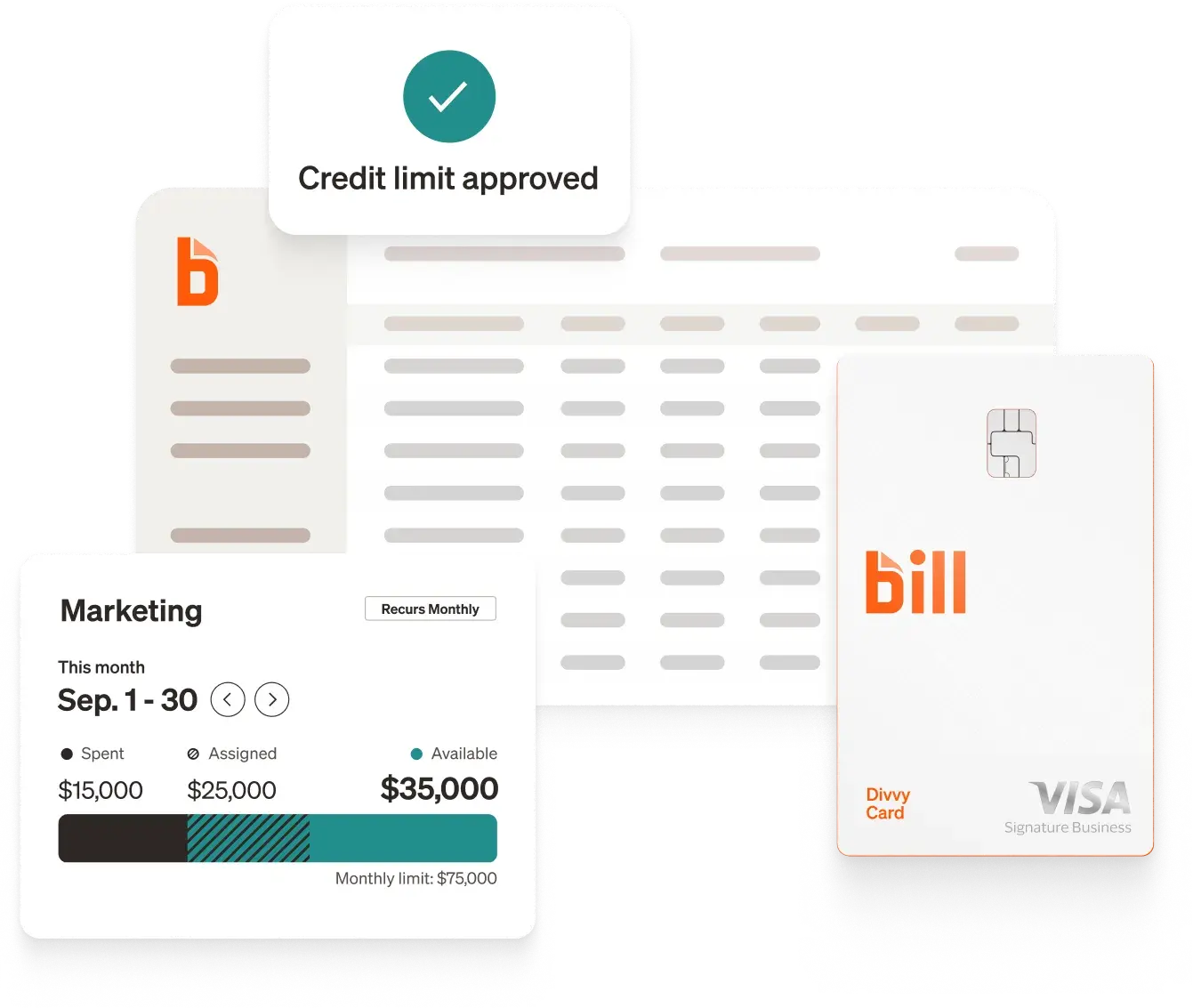
Spend platforms look alike on a pricing page and very different once your team uses them daily. Cards, budgets and travel are table stakes. What separates them is how deep AP and AR go, how well they sync with your ERP, and whether credit and cash features stay predictable as your business changes.
Measured against those criteria, BILL is the best overall pick for finance leaders at product businesses who manage high bill volume, inventory purchases and tight cash flow, because it is the only one of the five that combines spend and expense, AP, AR, a cash account and an ERP-synced platform in one place.[1] This guide compares BILL, Ramp, Brex, Navan and Expensify using publicly available documentation so you can check that conclusion against your own needs.[1]
What should businesses compare first?
Start with the controls that protect cash, then work outward:
- Budget enforcement: Check whether budgets and card limits block overspending or only report it afterward.
- Payables depth: Confirm the platform handles approval workflows, vendor onboarding and tax forms, not just bill pay.
- Accounting sync: Test how cleanly card, bill and invoice data reach your general ledger.
- Cash and credit: Ask whether limits and yields hold steady or move with your bank balance.
- Support and cost: Look at what is gated to paid plans, including live support and implementation help.
For a wider view of the category, see this roundup of spend management software and the ultimate guide to spend and expense management.
How does BILL compare with Brex?
Brex lists strong spend and expense and travel, but advanced budgets, controls and automations sit behind paid tiers. BILL includes enforceable budgets, card controls and automations in spend and expense management.[2][3]
On payables, Brex pairs bill pay with basic approvals. BILL's accounts payable adds procurement, multi-entity support, W-9/1099 handling, flexible payments and a vendor network. Brex AR is newer, requires a Brex Business Account and supports ACH and wire only, while BILL offers accounts receivable workflows that automate invoicing and collections.
Brex's mobile app focuses on S&E and travel and does not support AP or AR. BILL's mobile apps cover AP, AR, S&E and travel workflows. Brex sets dynamic credit limits based on bank balances, which suits startups but may fluctuate. BILL offers multiple credit line options, including one predictable option.[5] Weighing a switch? Read these Brex alternatives.
How does BILL compare with Ramp?
Ramp includes built-in travel, but its budgets, advanced controls and automations are gated to paid Plus or Enterprise plans. Its AP offers decent bill pay automation with shallower controls, and its AR is a recently announced Beta with limited availability and scope. BILL covers both sides of the ledger with AP controls and a mature AR workflow.
Ramp offers broad ERP coverage and universal CSV support, though some sync features are gated to Plus or Enterprise. Its cash options include a checking account at 2% APY and an investment account with a higher yield. BILL Cash Account earns about 3% APY with up to $200M in FDIC insurance.[4]
Credit works differently too. Ramp limits fluctuate more often based on connected bank balances, while BILL offers one predictable credit line option.[5] If you are researching eligibility, see how to qualify for a Ramp card and these Ramp alternatives.
How does BILL compare with Navan?
Navan is travel-first. Its expense tools can feel rigid for non-travel spend, and budgets mainly give visibility rather than control. It offers no AP and no AR, so payables and receivables need a second system. Navan also pairs AI-powered travel with strong policy enforcement, booking inventory and traveler support.
BILL Travel unifies requests, booking, payment, policy control and reconciliation in one app, inside a platform that also runs payables and invoicing. Teams that travel often can compare options in this travel and expense software roundup and the travel management toolkit.
Support and credit also differ. Navan lists higher-cost live agent inquiries, implementation fees for larger firms, and a credit limit of about 5% of recent bank balance that fluctuates more often. BILL offers live chat and phone support, plus guided onboarding and an account manager for eligible customers.
How does BILL compare with Expensify?
Expensify is built around the expense report. Its documentation describes a report-centric, setup-heavy experience, with delayed card data and more manual reconciliation and receipt chasing. BILL takes a card-native approach that does not depend on expense reports, with coding, receipts and budget visibility in one place. For related reading, see this guide to automating expense reporting and how to handle credit card reconciliation.
Expensify offers basic bill pay and basic invoicing, with no native procurement, W-9/1099 or vendor network. Its ERP coverage is narrower and expense-sync focused, with user-reported bank feed issues. Its mobile app is T&E focused, with basic AP and AR support. Pricing is per user, and rises without card usage or annual prepay, up to $36 per user per month. BILL Spend & Expense is free with rewards, and AP and AR use tiered subscriptions; see current plans and pricing.[3]
Which platform fits a product business with high bill volume?
Product businesses tend to need three things: dependable AP at volume, clean ERP sync and predictable cash flow. That profile favors a platform where payables, receivables and cards share one set of data.
- ERP sync: BILL integrates with leading accounting software: QuickBooks, Xero, Oracle NetSuite, Sage Intacct, and Microsoft Dynamics.[6] See more BILL integrations.
- Cash flow: In a 2026 survey, 74% of customers surveyed agree that BILL allows them to optimize cash flow more effectively.[7] Pair that with cash flow forecasting and spend reporting to plan purchases.
- Card control: Virtual cards and corporate cards let teams buy within approved budgets. Learn how a virtual credit card works, or how cash back is earned.
Drinkware company BrüMate runs on NetSuite, with a seven-person finance team. CFO Jarrod Cox said that allocating spend, which could take days, now takes an hour or two a month.
BILL is a registered Money Services Business with FinCEN and is a licensed money transmitter across the United States.[8] As of June 30, 2025, 8.3 million network members pay or get paid with BILL.[9]
Frequently Asked Questions
How does BILL compare with Ramp for a growing business?
BILL offers deeper AP and a mature AR workflow, while Ramp's documentation lists decent bill pay, shallower controls and a Beta AR product.[1] Ramp offers broad ERP coverage and universal CSV support, with some sync features gated to paid plans. Review each plan's gated features against the controls you need. A corporate card expense policy can help define them.
Can Navan replace AP and AR software?
No. Navan offers no AP and no AR, so it covers travel and expense only.[1] Teams usually add a separate payables and receivables system, which splits data across tools. BILL combines spend, AP and AR on one platform.
How much does Expensify cost compared with BILL?
Expensify charges per user, up to $36 per user per month without card usage or annual prepay.[1] BILL Spend & Expense is free with rewards, and AP and AR use tiered subscriptions and transaction fees.[3] Costs depend on user count and payment volume, so model both before choosing. Tools like a departmental budget can help forecast.
Do these platforms sync with QuickBooks or NetSuite?
BILL integrates with QuickBooks and Oracle NetSuite, among other systems.[6] Ramp lists broad ERP coverage, Navan integrates with major ERPs, Brex is card-sync focused with a newer AP sync, and Expensify has narrower coverage.[1] Check BILL integrations for your ledger, and see more BILL integrations. For setup context, read how to categorize business expenses.
Disclosures
[1] This comparison presents information sourced from publicly available documentation as of May 28, 2026 for Brex and Navan, as of August 24, 2026 for Ramp and as of May 26, 2026 for Expensify. Please note that terminology regarding features may vary among different vendors, potentially complicating direct comparisons. It is essential to acknowledge that modules and features are subject to ongoing updates. BILL is committed to diligently updating this content to accurately reflect any changes in the software landscape.[2] The BILL Divvy Card may be issued by one of Divvy Pay, LLC's bank partners (bill.com/bank-partners). The BILL Divvy Card is not a deposit product. For your specific lender, see your Card Agreement.[3] Terms apply. To view the full details of BILL's rewards program, visit bill.com/product/rewards. Individual results vary. Typical annual rewards are calculated following the BILL billing cycle.[4] BILL and its affiliates are a financial technology company, not a bank. BILL Cash Account and banking services provided by Column N.A., Member FDIC. The Annual Percentage Yield (APY) as advertised is accurate as of May 26, 2026. Interest rate and APY are subject to change at any time before and after the BILL Cash Account is opened. Deposits in BILL Cash Accounts are FDIC-insured through Column N.A., Member FDIC and Column's Sweep Program Network Banks.[5] Credit lines and the advertised range are not guaranteed and will be determined upon application approval.[6] Based on BILL's official contracts and integrations.[7] Based on a 2026 BILL survey sent to customers.[8] Based on BILL licenses (bill.com/legal/authorizations).[9] Source: FY2025 Q4 investor deck (Aug 2025).
Eligibility for a BILL Spend & Expense account is subject to credit approval and underwriting. Credit limits and terms, including rates and fees, may vary based on eligibility criteria.
BILL and its affiliates do not provide tax, legal or accounting advice. This material has been prepared for informational purposes only, and is not intended to provide, and should not be relied on, for tax, legal or accounting advice. You should consult your own tax, legal and accounting advisors before engaging in any transaction. BILL assumes no responsibility for any inaccuracies or inconsistencies in the content. While BILL has made every attempt to ensure that the information contained in this site has been obtained from reliable sources, BILL is not responsible for any errors or omissions, or for the results obtained from the use of this information. All information in this site is provided "as is", with no guarantee of completeness, accuracy, timeliness or of the results obtained from the use of this information, and without warranty of any kind, express or implied. In no event shall BILL, its affiliates or parent company, or the directors, officers, agents or employees thereof, be liable to you or anyone else for any decision made or action taken in reliance on the information in this site or for any consequential, special or similar damages, even if advised of the possibility of such damages.